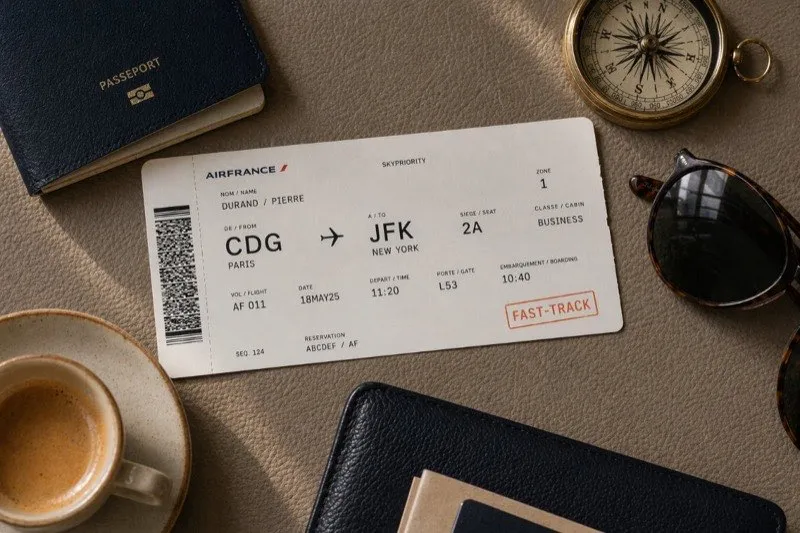
Flying Blue Status Match 2026: What's Live
Flying Blue's paid regional status match for 2026: eligible countries, fees, tier mappings, approval timing, and whether Gold or Platinum i…
Read article →Independent Miles Mosaic guide. No programme partnerships, no account linking, no scraped balances. Sources cited below; corrections welcomed.

Status matches still matter in 2026, but the market is no longer the easy buffet many roundups pretend it is. The broad, frictionless airline switches that once defined the category are rarer. In their place: public challenges with real flying or spend requirements, paid regional matches, and invitation-led fast tracks that are useful only if you actually qualify.
That distinction matters because status matching is usually a limited-use shortcut. Burn it on the wrong programme and the cost is not just a rejected application or a few wasted nights. It is the opportunity cost of locking yourself out of a better move later, when your travel calendar is heavier or a more relevant programme opens up. Crowdsourced datasets at StatusMatcher.com show how often otherwise-attractive matches go unused for exactly this reason.
This is the current landscape view: which opportunities are clearly live, which ones are selective, which ones are worth prioritising, and which big names should sit on your watchlist until you have a current official path in hand. For the mechanics of how to apply, what documents programmes ask for, and how challenges are structured, see our dedicated status match and challenge guide. For a deeper tactical look at one of the most interesting current options, see our Flying Blue status match guide.

The point is not to collect everything. It is to identify the small number of shortcuts that fit your routes, your residency, your spend profile, and your next 90 days of real travel.
The clearest current airline opportunities are much more segmented than older blog-era status matching suggests. Delta's challenge is public, but it is not casual. Atmos Rewards is public, but only for legal residents of the United States and Canada and only worth pursuing if you can fly Alaska- or Hawaiian-family services after approval. Flying Blue is live, but it is paid and region-specific. The Points Guy's 2026 airline status-match guide shows how the public field has narrowed: it lists Frontier and Spirit as not currently offering matches and notes that Southwest's A-List match closed to new applicants at the end of 2025.
Hilton Honors Status Match remains the easiest example. The current Hilton path is simple enough that an ordinary traveller can look at the next three months and know whether the challenge is realistic. Airlines increasingly want evidence that you are not just elite elsewhere, but transferable as actual revenue or actual flying behaviour.
A programme can have terms on a site without being broadly available. A challenge can be real without being public. A fast track can be attractive without being something most readers can access today. If you fail to separate those categories, you end up wasting money, effort, or a one-time match on an offer that never really belonged in your decision set.
For most readers, the most useful overview is not a romantic list of premium brands. It is a practical grid of what is genuinely usable right now.
| Programme | What is current | Best for | Confidence | Main catch |
|---|---|---|---|---|
| Atmos Rewards | Public airline status match for 90 days, then retain via 5,000 / 10,000 / 20,000 base points on Alaska and Hawaiian flights | U.S. and Canada flyers with real Alaska or Hawaiian travel ahead | High | Residency restriction, one-time use, and partner flying does not solve the retention requirement |
| Delta SkyMiles | Public Medallion Status Match Challenge for 90 days, then extend via MQDs | Travellers genuinely shifting paid flying or spend toward Delta | High | Revenue focus is now real, and Delta screens for meaningful prior engagement |
| Flying Blue | Paid status match in select regions with 12 months of status if approved | Residents of the eligible countries, in September 2026 Greece, Israel, and nine Latin American countries, who value SkyTeam Elite Plus | High | Paid, region-limited, and not universally available up to the same tier |
| Hilton Honors | Public hotel status match with Gold for 90 days, then Gold at 6 nights or Diamond at 12 nights | Travellers with upcoming hotel nights who want the easiest first win | High | One-time use, proof of recent competitor stays required, and only Base or Silver members are eligible |
| IHG One Rewards | Live 2026 fast track with Gold after 2 nights and Platinum after 5 nights | Invited corporate travellers who can use a valid corporate ID | High | Explicitly exclusive and not a broad public hotel match |
| American AAdvantage | Instant Status Pass framework remains published, including a status-match path for select members | Readers with a current invitation and a real Loyalty Points strategy | Medium | Selective and time-bounded enough that most readers should not treat it as a dependable public option today |

As of April 22, 2026, Alaska's Atmos Rewards has the clearest and most operationally usable public airline status-match page I could verify. Match eligible status from a listed airline, receive the equivalent Atmos Rewards tier for 90 days, and keep it by earning enough base points on Alaska and Hawaiian flights during that window.
The thresholds are unusually clear: 5,000 base points to keep Atmos Silver, 10,000 to keep Atmos Gold, and 20,000 to keep Atmos Platinum. The timing is also explicit. If you start by June and complete the challenge, you keep status through the end of the current calendar year. If you start between July and December and complete it, you keep status through the end of the next calendar year.
That makes Atmos Rewards easy to model and easy to misuse. It is excellent for West Coast travellers, Hawaii-bound travellers, and anyone whose next 90 days already contain plausible Alaska or Hawaiian flying. It is a poor choice for readers who simply like the idea of oneworld benefits but have no real Alaska- or Hawaiian-family flying ahead.
Two constraints matter most. The offer is only open to legal residents of the United States and Canada, and the retention flying has to be on qualifying Alaska or Hawaiian marketed and operated flights described in the terms. Codeshares, partner flying, award tickets, bonus points, and Saver fares do not rescue the challenge if your real calendar does not line up.
Delta's Medallion Status Match Challenge is one of the few major-airline offers that is both public and detailed enough to plan around. The programme will match eligible elites to Silver, Gold, or Platinum Medallion for 90 days. To extend the matched tier during the challenge window, the current published thresholds are $1,250 MQDs for Silver, $2,500 MQDs for Gold, and $3,750 MQDs for Platinum. Successful 2026 participants keep status through January 31, 2028.
The catch is that Delta now screens aggressively for real engagement. Applicants must have been SkyMiles members for at least 30 days, must have flown at least one Delta-marketed fare above Basic in the previous three years, and cannot have used Delta's match or complimentary Medallion pathways in 2023, 2024, 2025, or 2026. That is a very different posture from the old era of casual challenge hopping.
In practical terms, Delta is excellent for the traveller who already knows they can push meaningful paid Delta flying, eligible co-branded card MQD accrual, or Delta Vacations spend through the challenge window. It is much less attractive for the reader who hopes to improvise the activity later. Delta is still one of the best airline challenges in the market. It just no longer rewards vague intention.
Flying Blue is exactly the kind of offer that gets overstated in stale roundups. What is live today is not a universal free global match. What I could verify is a real paid status-match process at Flying Blue's dedicated status-match site. If approved, members receive 12 months of Silver, Gold, or in some countries Platinum status. Only one match is allowed per person.
The crucial nuance is geography. When I checked the official FAQ on September 18, 2026, the open offers were Greece, priced at EUR 89 to EUR 349, and a block covering Israel and nine Latin American countries (Argentina, Brazil, Chile, Colombia, Costa Rica, Ecuador, Paraguay, Peru, and Uruguay) at USD 99 for Silver, USD 299 for Gold, and USD 399 for Platinum, with Platinum ruled out for Brazil residents and, under a footnote on the same FAQ, for Argentina and Chile too. The United States and Canada offer, which charged USD 199 for Gold in the United States and never included Platinum, ended on June 13, 2026, the date View from the Wing reported it would close. It now sits in the FAQ's "recently ended" section alongside Italy, Singapore, Thailand, and earlier Asian and Middle Eastern campaigns, and apart from Greece, the United Kingdom, Germany, and the rest of April's European list no longer appear at all. That is precisely why broad blanket claims are so dangerous here.
For the right reader, Flying Blue is excellent. If you live in an eligible country, regularly transit Paris Charles de Gaulle or Amsterdam Schiphol, or want SkyTeam Elite Plus benefits with real near-term value, the paid fee can make sense. For the wrong reader, especially one assuming that every blogged Platinum pathway applies globally, it is a costly misunderstanding.
The same paid, country-gated model now reaches oneworld: Royal Jordanian sells a year of Sapphire-level status through StatusMatch.com, and we cover who can use the Royal Jordanian match and its crediting catch separately.
American Airlines belongs in the 2026 conversation because Instant Status Pass remains on aa.com and still includes a status-match path for select AAdvantage members. The published framework describes a four-month complimentary status period and makes clear that competitor-status matching can be part of the route in.
That said, the safest way to read American in 2026 is as a selective framework, not as one of the cleanest live opportunities. The public terms are invitation-led and time-bounded enough that most readers should not build a live strategy around them unless they have a current invitation or direct confirmation from American. If you do have that access, AAdvantage can still be unusually attractive because AAdvantage Loyalty Points make it easier than some rivals to combine flying, partner activity, and co-branded card spend. If you do not, treat it as interesting but non-actionable.
If I had to recommend one first status match to a smart but non-obsessive traveller in April 2026, it would still be Hilton Honors. The official page is clear. Submit proof of status and a qualifying stay from a competing programme, receive Gold for 90 days if approved, keep Gold with 6 nights, or earn Diamond with 12 nights inside the same 90-day window.
Hilton's page also sets out the guardrails clearly. The proof of stay has to be within the last 24 months. The benefit is one-time only. It is available only to members currently at Base or Silver who have not already enrolled in Hilton's Status Match benefit. That may sound limiting, but in practice it makes the offer easier to trust because the rules are legible.
This is why Hilton remains so useful. A traveller can look at the next three months and know whether the challenge is realistic. There is no geography fee table, no corporate invitation requirement, and no need to reverse-engineer an airline's evolving revenue metric. Hotel status is also easier for the average reader to feel immediately: breakfast or food-and-beverage credit, upgrades, and late checkout are concrete benefits rather than abstract prestige.
IHG's current "Level Up Your Status Faster" page is live and attractive. Register, stay 2 nights by December 31, 2026 for Gold Elite through 2027, or stay 5 nights for Platinum Elite through 2027. In pure maths, that is one of the more generous hotel fast tracks in the market.
The limiting factor is access. The terms say the member must be part of a corporate group expressly invited by an IHG Global Sales Key Account contact, must register under an active IHG One Rewards account, and must book using a valid corporate ID. That makes the offer highly relevant to invited business travellers and mostly irrelevant to readers browsing public lists in search of an easy click-through match.
That does not make IHG unimportant. It makes it narrow. In a trustworthy guide, narrow opportunities still belong in the discussion, but only with the gatekeeping language front and centre.
Most weak status-match content fails because it tries to sound exhaustive. A stronger approach is to be explicit about what has not been verified as a current broad public opportunity.
United is still central to status-match discussions, but during this review I did not verify a current broad public 2026 official challenge page from United itself that I would feel comfortable placing in the same bucket as Delta's public challenge page. That does not prove United never runs targeted or unpublished opportunities. It simply means readers should not plan around United until they have a current official route in hand.
Hyatt remains strategically important, and targeted or partner-led opportunities can exist. But during this review I did not verify a broad public Hyatt status-match page that justified calling it one of the best live public plays right now.
The same caution applies to Marriott. The programme matters. Marriott status matters. That is not the same thing as saying a current broad public status match is live and dependable today.
These are all strategically important brands for premium travel, but important does not mean currently running a broad public airline-to-airline status match. That distinction is where many older articles drift into inaccuracy.
There are also two naming corrections worth making because stale branding is one of the fastest ways to spot an outdated article.
Etihad is a useful example of the distinction. Its current tier page includes a temporary 25% reduction in qualification thresholds for existing members through March 31, 2027. That is a real status acceleration mechanism. It is not the same thing as a current airline-switcher status match.
The smartest strategy in 2026 is not to collect every badge available. It is to sequence your moves.
Start with Hilton if you have real hotel nights coming. It is the easiest way to learn how a challenge behaves, how much value you actually extract from elite benefits, and whether you enjoy playing this game at all.
Atmos Rewards is the strongest first airline move if your next 90 days can genuinely run through Alaska or Hawaiian flights. If the flights are not there, skip it.
Delta makes sense only when the spend is real and imminent. Do it before that activity dissipates elsewhere, not after.
Flying Blue becomes much more compelling, but only if you also live in an eligible country, which in Europe currently means Greece alone. If yours is open, especially with Platinum on offer, SkyTeam Elite Plus can pay back the application fee quickly in lounge access, priority treatment, and operational convenience.
Do not dismiss the opportunity just because it is not broad public. If you can exploit the Loyalty Points system effectively, American can still be one of the better selective plays in the market.
Treat IHG's fast track as a corporate perk, not a speculative public target. If your company qualifies, it is worth using. If not, move on.
The 2026 status-match market is still worth playing, but only if you stop treating it as a giant open field. The clearest current opportunities are a shortlist: Atmos Rewards for the right North American flyer, Delta for the traveller who can move real spend, Flying Blue for readers in the right regions, Hilton for the cleanest first hotel play, and IHG for invited corporate travellers. American still matters, but only when it is actually offered to you.
That is a narrower answer than many listicles promise, but it is a better one. In 2026, trust matters more than exhaustiveness. A short list of opportunities you can actually use is worth more than a long list of stale names and semi-mythical matches.
As of April 22, 2026, the clearest official opportunities I could verify are Alaska's Atmos Rewards status match, Delta's Medallion Status Match Challenge, Hilton Honors Status Match, Flying Blue's paid regional status match, and IHG One Rewards' exclusive corporate fast track. American Airlines' Instant Status Pass remains strategically relevant, but it should be treated as a selective framework rather than a broad public offer.
Generally yes. Hilton Honors is much easier to model and complete than most airline challenges. Airline programmes increasingly want real near-term flying, real spend, or both, while hotel programmes still tend to offer clearer qualification math and faster practical value.
No. The current Flying Blue status-match FAQ shows application fees that vary by tier and region. It is a paid match, not a universal free challenge.
Treat the programme as a watchlist item, not a current opportunity. Do not spend money, time, or a one-time switch decision on a stale third-party summary when you cannot confirm the offer from the airline or hotel programme itself.
Programme rules verified against the official sources below. External sites open in a new tab.
See your requalification forecast in under a minute. No account, and never a loyalty password.
Forecast my status, free →Share
Last reviewed: · How we research and update
Flying Blue's paid regional status match for 2026: eligible countries, fees, tier mappings, approval timing, and whether Gold or Platinum i…
Read article →A 2026 guide to airline and hotel status matches, challenges, and fast tracks: what is live, what documents you need, and how to use a matc…
Read article →Marriott Bonvoy in 2026: elite tiers, variable award pricing, PointSavers, Cash + Points, Stay for 5 Pay for 4, and when the programme dese…
Read article →