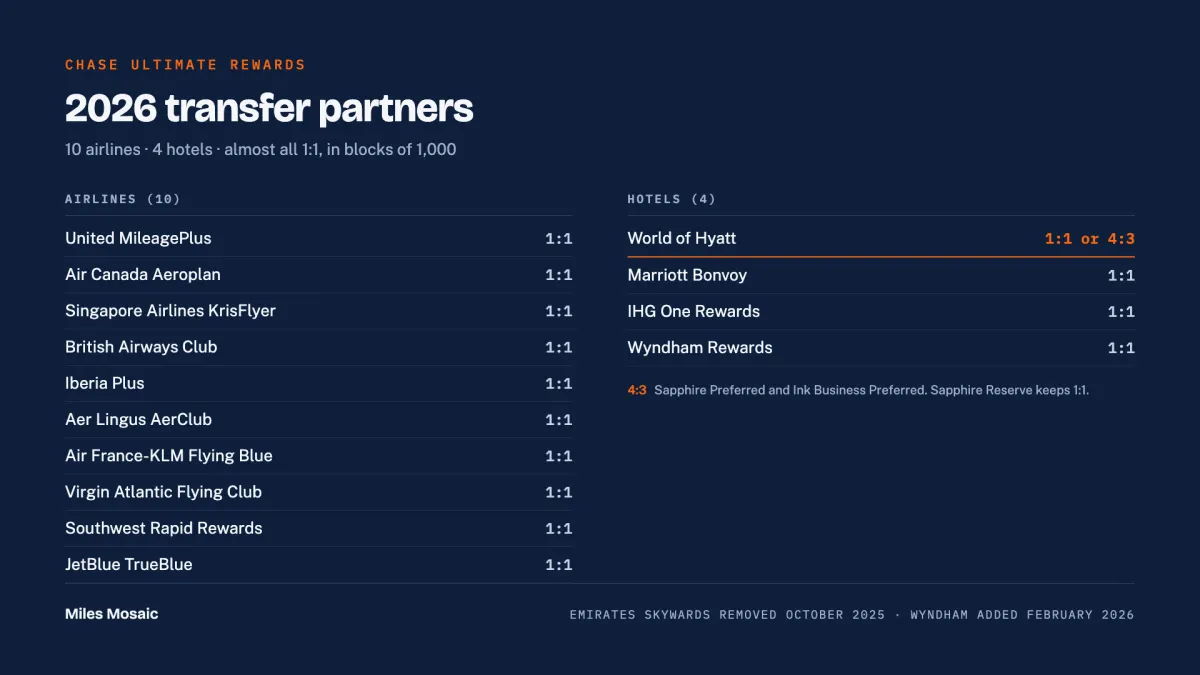
Chase Ultimate Rewards Transfer Partners (2026): The Full List, Ratios and the Hyatt Catch
Chase Ultimate Rewards has 14 transfer partners in 2026: 10 airlines, 4 hotels, every ratio and transfer time, and the World of Hyatt 4:3 s…
Read article →Independent Miles Mosaic guide. No programme partnerships, no account linking, no scraped balances. Sources cited below; corrections welcomed.

The loyalty world loves flexibility in theory and destroys it in practice. That is the central tension behind pooling and transfer strategy in 2026. Travellers know they should stay nimble, but the moment a family trip gets serious or award space appears, points move fast. Sometimes that is smart. Often it is how a flexible balance becomes trapped.
The goal is not to avoid moving points entirely. It is to understand when pooling preserves value, when transfers reduce it, and when a household strategy gives you leverage instead of friction. Two practical roundups give a useful starting map: The Points Guy's family-pooling guide covers airlines, and AwardWallet's pooling-options overview covers bank, hotel and airline programmes.

Many guides blur them together. That is a mistake.
Pooling means multiple people contribute to a shared or coordinated balance within the same programme. It is usually strongest when the programme was designed for households or families from the start.
Transferring means moving value from one system to another: from a bank currency to an airline, from a hotel scheme to a partner, or from one account holder’s balance into another account structure if the programme allows it. This is often one-way, sometimes slow, and usually where people give up too much optionality.
Pooling is about consolidation. Transfers are about commitment. That distinction should guide most of your decisions.
British Airways Club household accounts remain one of the clearest household-use programmes because Avios pooling still supports family logic well. If your household already uses Avios intelligently, pooling inside that ecosystem can be far cleaner than trying to juggle separate small balances across multiple members.
The catch, as always, is that household rules are real rules. You should not treat them as informal point trading. This is a structured family feature, not a casual flexibility loophole.
Hilton Honors points pooling remains one of the easier hotel programmes for collaborative point use. Current Hilton public materials still allow members to pool points with other members, which makes Hilton particularly useful for families or couples trying to pull together enough balance for a meaningful stay.
Because hotel awards can get expensive quickly, the practical value of pooling is often higher than travellers expect. A hotel pooling feature can turn several mediocre balances into one actually usable redemption.

World of Hyatt point combining remains useful but more procedural. Current Hyatt materials still rely on a point-combining structure that is less frictionless than some members would like. That does not make it weak. It makes it something you should plan for rather than improvise at the moment of booking.
Aeroplan Family Sharing is the perfect example of why current verification matters. Older articles describe Family Sharing as either fully open or indefinitely suspended. Neither is accurate in 2026. After Air Canada suspended new sharing-pool creation in August 2023 because of widespread fraud, the programme reopened enrolments on 27 February 2025 with a mandatory verification step.
Every member who wants to create, join or invite others into a Family Sharing pool now has to be a Verified Aeroplan member. The four accepted verification paths are: completing at least two Air Canada flights in separate bookings within the past five years, being the primary cardholder of a properly linked Aeroplan co-brand credit card, completing instant biometric verification with a government-issued photo ID and a live selfie, or doing in-person verification at select airports. A household with one frequent Air Canada flyer and one non-flyer can no longer take the easy route of having both members earn flexible points and dump them into a single sharing pool without that second person also passing verification.
This is exactly the kind of rule drift that makes older points advice dangerous, and forums like FlyerTalk's Aeroplan forum are often where ground-truth member reports surface first.
American Airlines is the most common counter-example to the entire pooling category. Despite being the largest US airline loyalty programme by deferred revenue, AAdvantage still does not offer family pooling. The only intra-account movement available is paid transfer at $5 per 1,000 miles, capped at 200,000 miles per calendar year. That makes American almost the worst of the major US programmes for households trying to consolidate balances, because every transfer carries a five-times-current-buy-rate friction cost on top of whatever each member's miles were originally worth.
The practical answer for an AAdvantage household is not to pool but to nominate a single primary booker. Award redemptions on AA do not require the ticket holder to be the account holder, so a parent with 200,000 AAdvantage miles can simply ticket a partner or child directly. That avoids the transfer fee entirely, but at the cost of asymmetry: only the account holder accrues Loyalty Points toward elite status from those redemptions.
Consider the kind of balance most engaged couples actually have rather than the one points blogs imagine. A couple with 80,000 AAdvantage miles, 30,000 Aeroplan points and 45,000 Hilton Honors points, planning a long-weekend trip from the US east coast to Paris with three nights at a Hilton Paris property in the autumn shoulder season, faces a clearer decision than the raw numbers suggest.
The 30,000 Aeroplan points are nearly worthless for transatlantic business, Air Canada's Aeroplan chart prices a one-way US east coast to Paris business award at around 70,000–80,000 points. They are, however, useful for a one-way premium-economy or short-haul positioning leg on a Star Alliance partner, or as a buffer to combine with new Aeroplan earn before the trip. They should stay in Aeroplan and be verified into a sharing pool only if a near-term Star Alliance booking is realistic.
The 80,000 AAdvantage miles are the trip's engine. A web-special AAdvantage award on partner British Airways or Iberia from a US east coast hub to Paris-CDG via London or Madrid can price as low as 57,500 miles one-way in business when promotional space is open, leaving room for the return half on cash or a Reward Flight Saver Avios booking. The 80,000 miles should not be transferred anywhere. They should be held in the primary booker's account and used directly.
The 45,000 Hilton Honors points are the easiest to consolidate, because Hilton allows fee-free pooling of up to 500,000 points between accounts. If both partners have Hilton accounts with at least 30 days of activity since enrolment, one partner pools their balance into the other's and the consolidated 45,000-plus-whatever-the-second-partner-holds balance becomes a clean three-night booking budget. That is genuinely useful, because a mid-tier Paris Hilton in shoulder season is typically 70,000–85,000 points per night, and consolidation lets the household decide whether to top up with cash or with a small purchase of Hilton points during a sale.
The trip-level lesson is that none of these balances should be transferred between programmes. Each currency does exactly one job. Transfers come into the conversation only if a fourth balance, flexible bank points, is needed to top up the AAdvantage or Hilton side and the relevant award space is already on hold.
Bank-to-airline transfer bonuses are now frequent enough to plan around but unpredictable enough that you should never assume one is coming. According to Frequent Miler's running analysis, American Express Membership Rewards runs roughly 20 transfer-bonus promotions per year, Citi ThankYou roughly 10, Chase Ultimate Rewards 8 to 10, and Capital One Miles 7 to 8. The most frequently bonused partners are Air France-KLM Flying Blue, Virgin Atlantic Flying Club, and the various Avios programmes, almost always at 20 to 30 percent over the standard ratio.
The disciplined approach is to keep flexible balances large enough to act when a bonus does appear, but small enough that you are not over-allocated to any single bank ecosystem. As The Points Guy's history of transfer bonuses shows, the most valuable bonuses cluster around specific events, programme launches, holiday-season pushes, and end-of-quarter clearance windows, and tend to repeat seasonally. A 25 percent Amex-to-Flying Blue bonus in March, for example, has appeared in some form in most of the past four years.
The single most expensive mistake in this category is transferring flexible points to an airline before an award is actually on hold. Every transfer is one-way, every transfer-ratio change can be announced with weeks of notice, and every devaluation that lands while your miles are in transit destroys part of your purchasing power.
Three real-world examples in the past 18 months illustrate the trap. American Express Membership Rewards' move to a 5:4 ratio with Asia Miles from 1 March 2026 means anyone holding Amex points speculatively for a future Cathay redemption now needs 25 percent more to reach the same balance. Cathay's 1 May 2026 devaluation added another 3 to 4 percent on top of that. Avios' 15 December 2025 Reward Flight Saver increase hit anyone who had transferred Chase or Amex points into a UK Club account speculatively. Members who had moved points six months before any of these announcements lost ground twice, once on the ratio, once on the chart.
The defensive rule has been stable for years and applies in 2026 more than ever: do not transfer flexible points until the award space is on hold. Most major airline programmes hold an award seat for 24 to 72 hours through their customer-service phone line once you have a record locator, and most bank transfers complete within minutes to a day. The window between confirming space and ticketing is long enough to move points safely. The window between speculating and ticketing is long enough for the programme to reprice against you.
The temptation in a household is to centralise everything. That is not always optimal. A good family strategy usually separates balances into three groups:
This structure prevents a common failure mode: the household moves too much too early, then real availability appears somewhere else.
Transfer only when you are ready to book. In 2026 this is not stale beginner advice. It is the core defensive rule of the entire game.
Why? Because both sides of the transfer can change against you. Banks can change ratios or partner rosters. Partner programmes can change award pricing or make live value harder to reach. Once you transfer, you lose optionality and usually cannot reverse the move.
The 2026 Membership Rewards change to Cathay Pacific Asia Miles is a useful reminder of why this matters. Transfer timing is not just about availability. It is also about protecting your optionality until the moment it is actually worth spending. Even the US DOT's Office of Aviation Consumer Protection has flagged that loyalty programme terms can change with limited notice.
If the booking is not real, the transfer usually should not be either.
Many family strategies fail not because the points are insufficient, but because nobody decided who is actually responsible for monitoring space, moving points, and ticketing fast.
Programmes that support household or family features are often far easier to use than improvised transfer workarounds. Lean into the structures that already exist.
Some transfers are instant. Some are not. Some family combination processes are administratively slower than you want them to be. That friction should be part of the strategy, not an unpleasant surprise.
That last point matters. Many households like the feeling of having everything in one place. But the neatest points structure is not always the strongest one.
Pooling and transfer strategy is really a discipline of controlled commitment. Pool where the programme is designed for it. Keep bank points flexible until a booking is real. Verify current rules before assuming a household feature is still open or unchanged. And decide in advance which balances are meant for family consolidation and which are meant to stay liquid.
The families who do this well are not just better organised. They are harder to trap into bad redemptions.
Programme rules verified against the official sources below. External sites open in a new tab.
See your requalification forecast in under a minute. No account, and never a loyalty password.
Forecast my status, free →Share
Last reviewed: · How we research and update
Chase Ultimate Rewards has 14 transfer partners in 2026: 10 airlines, 4 hotels, every ratio and transfer time, and the World of Hyatt 4:3 s…
Read article →A 2026 guide to ultra-long-haul award strategy: the programmes, route types, and booking frameworks that still create genuine premium-cabin…
Read article →A 2026 guide to airline-miles economics: how airlines monetise loyalty, why flying is no longer the main earning engine, and how smart flye…
Read article →