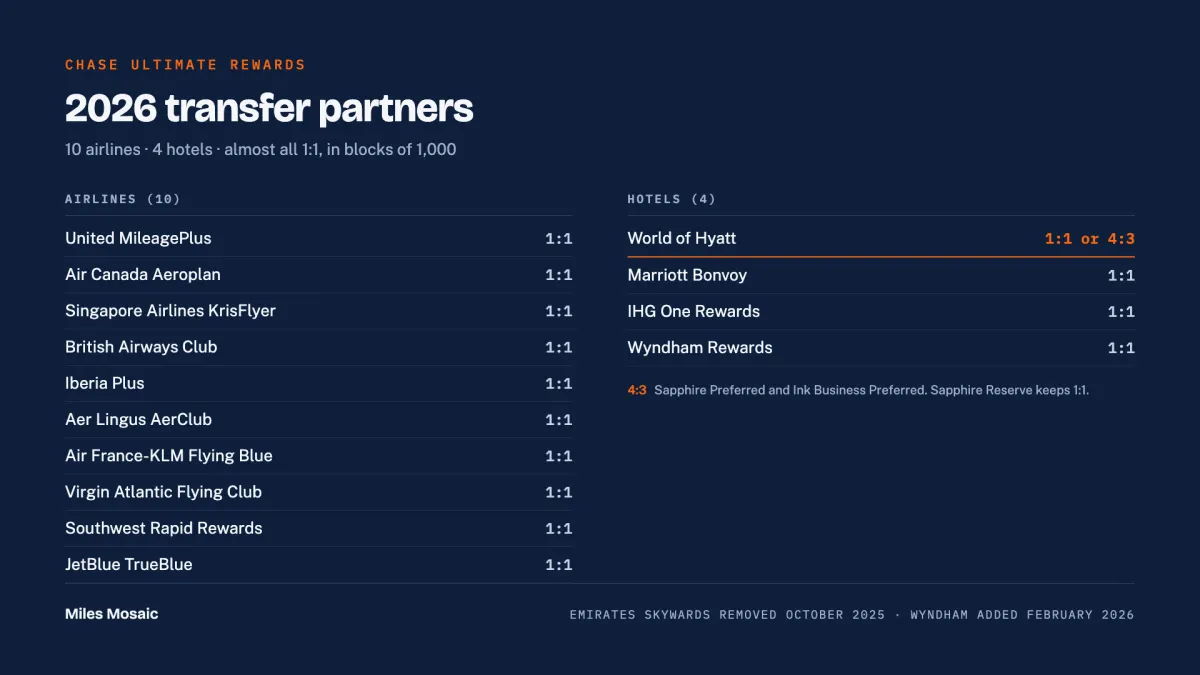
Chase Ultimate Rewards Transfer Partners (2026): The Full List, Ratios and the Hyatt Catch
Chase Ultimate Rewards has 14 transfer partners in 2026: 10 airlines, 4 hotels, every ratio and transfer time, and the World of Hyatt 4:3 s…
Read article →Independent Miles Mosaic guide. No programme partnerships, no account linking, no scraped balances. Sources cited below; corrections welcomed.

American Express Membership Rewards transfer partners are the airline and hotel loyalty programmes that let you move Membership Rewards points out of Amex and into a frequent-flyer or hotel account, usually to book award flights or hotel stays. In 2026 the network spans sixteen airlines and three hotel chains, most converting at a one-to-one ratio.
Membership Rewards is the points currency you earn on personal and business cards such as the American Express Gold Card, the Platinum Card and the Business Gold Card. The points sit in your Amex account doing nothing on their own. Their value is unlocked the moment you transfer them to a partner programme and redeem for travel. This guide explains how the transfer system works in 2026, which partners convert at a true one-to-one rate, which ones quietly do not, and the handful of rules that separate a smart transfer from a wasted one.
The mechanics are simple. You log into your Amex account, choose a partner, enter a transfer amount in increments of 1,000 points, and confirm. Amex publishes the full partner roster and the conversion rules on its official transfer points page, and you can browse the same partners on the broader Membership Rewards programme hub. Before any transfer, you must first link your loyalty account to your Amex profile, which is a one-off step per partner.
Two rules matter more than any other. First, the minimum transfer is 1,000 points, and you move points in 1,000-point blocks. Second, and this is the one that trips people up: transfers are irreversible. Once points land in a partner account, Amex cannot pull them back. If you transfer 80,000 points to an airline and then find the seat you wanted is gone, you are stuck with 80,000 airline miles you may not be able to use well. That single fact drives the most important behaviour in this whole article, which we cover below.
The headline most guides repeat is that Amex transfers happen at 1:1. That is true for the large majority of airline partners, but not all of them, and the exceptions are exactly where people lose value. Here is the 2026 picture.
All of the above convert 1,000 Membership Rewards points into 1,000 partner miles. The variation between them is timing, not ratio. Instant partners are convenient when you have found a live award seat and need to book before it disappears. Partners that take 24 to 48 hours, including ANA, Cathay Pacific, Iberia and Singapore, demand more planning, because the seat you saw may be gone by the time the miles arrive. Always treat the published timing as a guide rather than a guarantee, since processing can run faster or slower depending on the partner and the time of day.
This is the part to read carefully, because several widely used guides gloss over it. As of 2026, the following airline partners transfer at worse than 1:1:
The lesson is that a transfer ratio is meaningless without the partner's redemption value behind it. An 800-mile result on Emirates can still buy an excellent premium-cabin seat, while a 1,600-point result on a low-value programme can be worth less in cash terms. Always ask what the resulting miles will actually book, not just how many of them you receive. This is precisely why two cardholders can transfer the same number of points and walk away with wildly different real-world value: the redemption chart, not the ratio, is what determines the outcome.
One partner has gone. Amex removed Etihad Guest as a Membership Rewards transfer partner on 30 June 2026, with the last 1:1 transfers accepted on 29 June 2026, a change reported by both The Points Guy and other trade outlets. If you were holding Membership Rewards points for a specific Etihad redemption, that route is now closed from Amex. Anyone who resisted the urge to move points across just to beat the cutoff lost nothing, which is the point the rest of this guide keeps making: speculative transfers are how value gets lost. Etihad Guest remains a transfer partner of other flexible currencies including Capital One, Citi ThankYou and Bilt, so the programme is still reachable, just not from Amex.
The Etihad exit is a useful reminder that a transfer partner list is never permanent. Programmes are added and removed, ratios are adjusted, and timing windows change. The practical takeaway is not to panic about any single partner leaving, but to internalise the broader principle: the value of a flexible currency lies in keeping your options open and acting only when you have a concrete plan. A partner leaving the roster only hurts you if you were relying on it speculatively in the first place.
Amex has three hotel transfer partners, and this is where the 1:1 assumption breaks down most sharply.
At first glance Hilton looks generous: double the points. It is not. Hilton Honors points are simply worth far less per point than Membership Rewards points, so the 1:2 ratio is a partial correction, not a bonus. In most analyses, transferring Membership Rewards to any hotel programme is a poor use of the currency. Hotel points are usually cheaper to earn directly through co-branded hotel cards and stays, and Membership Rewards points are far better deployed on airline awards where the per-point value runs much higher. Treat hotel transfers as a last resort, useful only to top up an account that is a few thousand points short of a specific free night.
There is one narrow scenario where a hotel transfer makes sense. If you are sitting at, say, 48,000 Bonvoy points and a free night you want costs 50,000, transferring the 2,000-point gap from Amex is entirely reasonable: the alternative is leaving a redemption on the table. What you should avoid is the wholesale conversion of a large Membership Rewards balance into hotel points in the hope of finding a use later. That converts a flexible, high-value currency into a rigid, low-value one before you have any concrete reason to do so.
Amex regularly runs limited-time transfer bonuses on specific partners. A bonus adds extra miles on top of the standard ratio, typically in the range of 10 to 40 percent. During a 40 percent bonus, transferring 10,000 points to a partner yields 14,000 miles instead of 10,000. Over the past two years Virgin Atlantic Flying Club, Air France-KLM Flying Blue, British Airways and Avianca LifeMiles have all featured in these promotions.
Three things to understand about bonuses. First, they are frequently targeted, meaning the same offer may appear for one cardholder and not another, so check your own account rather than assuming a publicised bonus applies to you. Second, they convert a good-value partner into an excellent one, but they cannot rescue a weak partner: a 40 percent bonus on a low-value programme still produces low-value miles. Third, a bonus is only worth chasing if you have a redemption you would make anyway. Transferring 100,000 points during a bonus, with no plan, leaves you holding 140,000 miles you may struggle to use, which brings us to the central rule.
It is also worth tracking bonuses over time rather than reacting to each one in isolation. The strongest partners tend to recur in these promotions on a fairly predictable rhythm, so if you miss a Flying Blue or Virgin Atlantic bonus this quarter, another is usually not far off. That predictability is itself a reason not to transfer speculatively: there is rarely a true now-or-never moment, and patience almost always serves a flexible currency better than haste.
Because transfers are irreversible and points are far more flexible than miles, the disciplined approach is to transfer only when you have already found a specific award you intend to book. The right sequence is: search the partner programme first, confirm the exact award seat or room is available and bookable, calculate precisely how many miles you need, then transfer that amount (rounded up to the nearest 1,000), and book immediately.
Doing it the other way around, transferring first and hunting for a seat afterwards, is the most common and most expensive mistake in this hobby. Award space can vanish in hours. Programmes devalue their charts with little notice. Miles sitting in an airline account are exposed to that single programme's whims, whereas points sitting in Amex can still flow to sixteen different airlines. Keeping points as points for as long as possible preserves optionality, and optionality is the entire reason a transferable currency is more valuable than any single airline's miles. The neutral guidance from outlets such as NerdWallet reaches the same conclusion: do not speculatively transfer.
There is one practical wrinkle worth naming. Many airline programmes will let you hold an award booking briefly, or will price an award before you commit, which means you can often confirm availability and the exact mileage cost without having the miles in your account yet. Use that to your advantage. Pin down the seat, note the precise number of miles required, and only then return to Amex to transfer. The few minutes this adds to the process are the cheapest insurance you will ever buy against an irreversible mistake.
Within the partner list, certain redemptions consistently deliver outsized value. None of these are guarantees, since award pricing shifts, but they remain the most cited 2026 sweet spots among frequent travellers:
The common thread is that the best value comes from premium-cabin international awards, not domestic economy, where points often return less than a cash purchase would. Run the numbers each time: divide the cash price of the seat by the miles required, and only transfer when the implied value comfortably beats what you would get from a flexible Pay with Points or statement-credit redemption. As a rough benchmark, a Pay with Points or statement-credit option tends to lock your points in at a fixed, modest rate, so a transfer only makes sense when the award you have found clears that bar by a comfortable margin rather than a sliver.
Most transfers are free, but US-domiciled airline programmes carry a federal excise tax recovery fee. For Delta SkyMiles and JetBlue TrueBlue, Amex passes on roughly US$0.0006 per point, which works out to about US$6 per 10,000 points, capped at US$99 per calendar year. It is small, but real, and worth factoring into a large Delta transfer.
On timing, never rely on an instant transfer staying instant. Build a buffer. If your chosen partner is one of the 24-to-48-hour group, only transfer once you are confident the award will still be there, or accept the risk. When a seat is genuinely scarce, favour an instant partner if a comparable redemption exists, because speed protects you from losing the space mid-transfer. It also pays to start the link-your-account step well in advance, since the one-off process of connecting a loyalty programme to your Amex profile can itself take time to verify, and you do not want that delay standing between you and a seat that is about to disappear.
Membership Rewards is one of the most flexible points currencies available in 2026 precisely because of this partner network. The discipline that separates good outcomes from poor ones is straightforward: know which partners are not 1:1 (Emirates, JetBlue and Aeromexico), treat hotel transfers as a last resort, wait for a meaningful transfer bonus on a partner you would use anyway, and never, ever transfer without a confirmed redemption in front of you. Keep your points as points until the moment you book, and the network does the rest.
See your requalification forecast in under a minute. No account, and never a loyalty password.
Forecast my status, free →Share
Last reviewed: · How we research and update
Chase Ultimate Rewards has 14 transfer partners in 2026: 10 airlines, 4 hotels, every ratio and transfer time, and the World of Hyatt 4:3 s…
Read article →A plain-English guide to every major airline and hotel status currency: what Tier Points, MQDs, PQPs, XP and Loyalty Points are, how each i…
Read article →A practical 2026 guide to using transferable credit card points for airline reward flights: search, transfer windows, and how not to lose t…
Read article →