Flying Blue Status Tiers Explained: Silver, Gold, Platinum and Ultimate in 2026
Flying Blue Silver, Gold, Platinum and Ultimate in 2026: the XP each tier needs, how the deduction and qualification period really work, an…
Read article →Independent Miles Mosaic guide. No programme partnerships, no account linking, no scraped balances. Sources cited below; corrections welcomed.
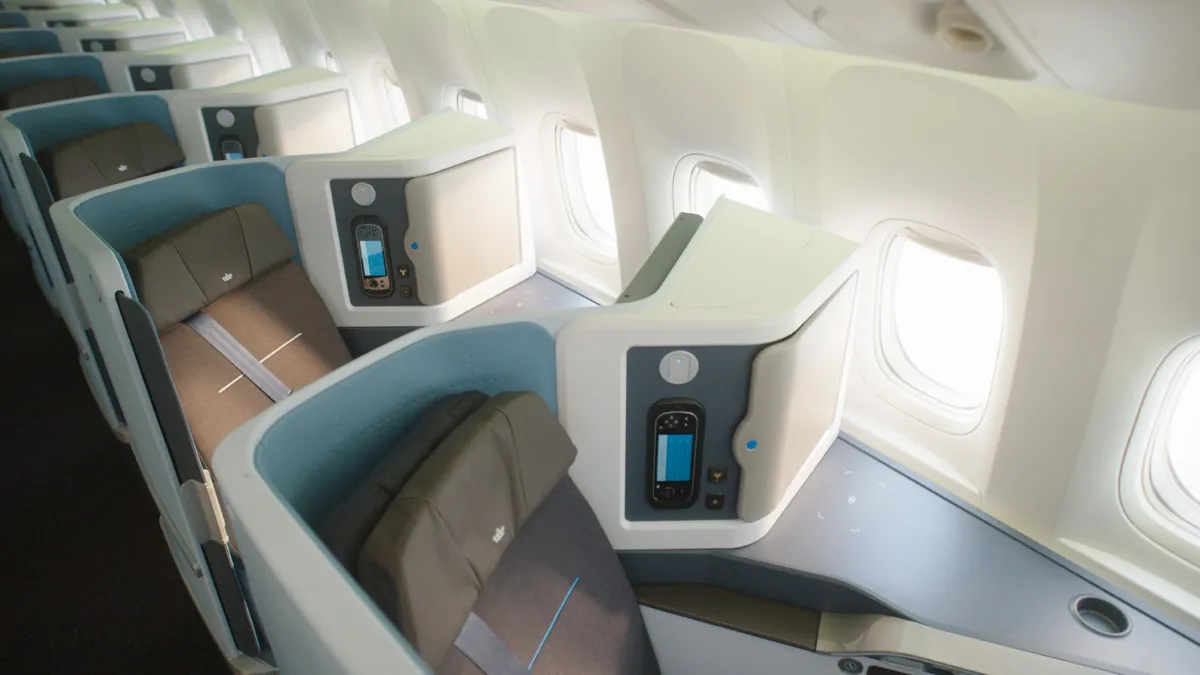
From 8 September 2026, an award ticket on an Air France or KLM flight stops being one thing and becomes three. Flying Blue is introducing Light, Standard and Flex award fares, mirroring the branded fare structure it has used on cash tickets for years. The trigger is the booking date, not the travel date.
The headline mileage price survives. What it buys does not.
Flying Blue publishes the inclusion tables in full on its own site. Read across the row for your cabin rather than assuming the pattern is the same in each, because it is not.
| Light | Standard | Flex | |
|---|---|---|---|
| Economy: checked bag | None | 1 x 23kg | 1 x 23kg |
| Premium Economy: checked bag | None | 2 x 23kg | 2 x 23kg |
| Business: checked bag | 1 x 32kg | 2 x 32kg | 2 x 32kg |
| Changes | Not included | 70 euros | Included |
| Refunds | Not included | 70 euros | Included |
| Advance seat selection | Extra cost | Extra cost | Included |
| SkyPriority (Premium and Business) | Included | Included | Included |
| Lounge access: Business | Extra cost | Included | Included |
Three things in that table are being reported incorrectly elsewhere, and each one changes the practical advice.
Business Light keeps a checked bag. One piece at 32kg. The "Light strips your baggage" framing is accurate for Economy and Premium Economy, and wrong for Business.
Standard does not restore advance seat selection. Seat selection is chargeable in Light and in Standard, in all three cabins. Only Flex includes it. If you have been told that Standard puts you back where you were before, that is the piece it does not put back. Flying Blue describes only the new structure, so whether seat selection was free on award tickets before 8 September is worth confirming against your own past bookings.
Lounge access is a Business-cabin story and nothing else. An Economy or Premium Economy award never included lounge access, so nothing is being taken away there. The routes into a lounge run through status, cards and memberships, not through the fare. In Business, access moves from included to chargeable at the Light level, and Business Light is limited to the O and Z booking classes, so it will not appear on every itinerary.
One further mechanical rule is worth knowing: brands combine only with themselves across cabins. An Economy Light outbound can pair with a Business Light return. It cannot pair with a Business Flex return.
Flying Blue has published no mileage prices and no differentials on its own page. Every number in circulation comes from examples the airline supplied directly to journalists, which is a meaningful distinction. They are airline figures, but they are illustrative examples rather than a chart, and they were never posted publicly.
On the examples Flying Blue gave to Head for Points and The Points Guy, a one-way Paris to New York Business award prices at 60,000 miles plus 527 euros at Light, 75,000 plus 527 euros at Standard, and 110,000 plus 262 euros at Flex. The same route in Premium Economy runs 40,000, 50,000 and 85,000 miles. In Economy it runs 25,000, 30,000 and 50,000. A short intra-European hop from Berlin to Barcelona was quoted at 10,000, 13,000 and 17,000 miles, with the same cash component across all three.
Those figures repay a minute of arithmetic.
Moving from Light to Standard in Business costs 15,000 extra miles, a 25 per cent increase, for a second bag and the right to change or refund for 70 euros. Flying Blue does not say whether that 70 euro fee is charged per passenger, per direction or per booking, and the difference for a family booking a return is substantial. Moving to Flex costs 50,000 more than Light, an 83 per cent increase, but roughly halves the cash, from 527 euros to 262 euros. In Premium Economy the Flex step is steeper still, at 112.5 per cent more miles than Light. The intra-European example is the one that breaks the pattern: Light to Standard there is a 30 per cent increase, higher than any long-haul cabin.
Whether any of that is a good redemption is a separate question from whether it is a worse one, and the two get conflated in a week like this. The cents-per-point test still applies. A Flex fare that costs 50,000 more miles to save 265 euros in cash is buying that cash back at about 0.53 euro cents a mile, which is poor value in Flying Blue terms. The flexibility and the seat selection may still be worth it. The cash saving on its own is not the argument.
The cash reduction on Flex is the part most often misread. Flying Blue describes Flex only as carrying a lower mandatory cash contribution. It does not say the reduction targets carrier-imposed surcharges, and it does not say the reduction is confined to long-haul. On the examples given, the intra-European fare showed no cash reduction at all, so treat the halving as something the long-haul examples happen to show rather than a rule the airline has stated.
This is the detail with the sharpest edge, and it drew the least coverage. Stand-alone partner-airline awards are untouched. Book Kenya Airways or Delta through Flying Blue and nothing about this change applies. But an itinerary that combines an Air France or KLM flight with a partner flight will be sold at the Standard fare only.
So the cheapest price disappears precisely on the connecting itineraries that a Flying Blue member outside Europe is most likely to build. If your route to Amsterdam involves a partner sector at either end, the Light fare is not available to you.
Four things are explicitly unaffected, all confirmed on Flying Blue's own page:
Here the reporting gets ahead of the airline, and it is worth being careful.
Flying Blue's page says that benefits linked to your status remain unchanged and continue to apply on the day of departure, giving additional baggage allowance and waived change and refund fees as its examples. It names no tier. It does not mention lounge access anywhere in that passage.
That leaves two widely repeated claims unsupported. The first is whether Gold keeps lounge access on a Business Light award: no source, primary or secondary, states this tier-specifically. The second is whether Platinum and Ultimate can cancel a Light award without a fee, and there is a logical gap nobody has resolved. Light is described as refunds not included, not refundable for a fee. A status benefit that waives a fee cannot obviously convert a non-refundable fare into a refundable one, and the airline's own wording ties the protection to the day of departure, which does not naturally describe cancelling weeks earlier.
What is attributable is narrower and more interesting. Flying Blue told Head for Points that elite members retain all status benefits on Light fares, including access to additional and lower-priced award inventory for Platinum, Platinum for Life and Ultimate. That is the only genuinely tier-specific statement available, and it points at the real design intent: the gap between having status and not having it has widened. If you have been undecided about whether to chase Flying Blue status this year, this change moves the maths a little in favour of doing it.
One more item sits on a single source. The Points Guy reports, from Flying Blue, that Promo Rewards will continue but will be sold under the Light fare type, which would make the programme's discounted monthly awards non-changeable and non-refundable. That is consequential, it is airline-supplied, and it appears on no airline page.
Not much, and that is the honest answer. This is not a chart increase you can front-run by speculatively booking, because the cheapest mileage price is not going up.
Two situations do reward acting. If you are holding miles for a Business award on Air France or KLM metal and you value lounge access on the day, booking before 8 September gets you today's single-fare ticket with lounge access included at the current price. After that date the equivalent is Standard, at 25 per cent more miles on the example given. And if your itinerary mixes Air France or KLM with a partner sector, book it now, because from 8 September that combination is Standard-only and the Light price will not be offered to you at all.
Otherwise, the sensible move is the unglamorous one: know what you are holding and where. Flying Blue miles sitting in an account are one input; what your bank points can reach, and on what timescale, is another. Miles Mosaic exists for that side of the problem, with 31 programmes in one view, so you can see whether the trips you have already booked still reach the tier that makes this change a non-event for you.
Air France-KLM has not made its awards more expensive. It has made the cheap award worse and charged for the difference, which is a different thing and a harder one to argue with. The entry price is intact, the airline can say nothing went up, and every individual removal has a price attached to it.
It is also not isolated. From 25 August, American's upgrade change will preserve complimentary upgrades for elites while landing them in Premium Economy rather than Business on a defined list of transcontinental and Hawaii routes, which are the routes people chase status for. British Airways is separately reported to have cut Avios earning on Japan Airlines-marketed flights this month by splitting one earning table in two by operating carrier. In each case the headline benefit survives and its substance is quietly reduced, which is now a documented pattern rather than a coincidence. The response to a devaluation is rarely to panic-book; it is to work out which of your balances the change actually touches, and to stop treating the others as though it did.
The consistent element is who absorbs it. Flying Blue is explicit that elites keep their benefits on the cheapest fare, and that the top three tiers keep privileged award inventory. If you hold status, this is close to a non-event. If you do not, restoring the baggage and the paid change right costs 20 per cent more miles in Economy, 25 per cent in Premium Economy and Business, and 30 per cent on the intra-European example, and Flex, the only band that includes advance seat selection, runs between 70 and 112.5 per cent above Light depending on cabin and route.
For a fuller picture of how the programme works either side of this change, our complete Flying Blue guide covers XP, tier thresholds, miles validity and the redemption landscape.
See your requalification forecast in under a minute. No account, and never a loyalty password.
Forecast my status, free →Share
Last reviewed: · How we research and update
Flying Blue Silver, Gold, Platinum and Ultimate in 2026: the XP each tier needs, how the deduction and qualification period really work, an…
Read article →Flying Blue in 2026: how XP works, current Silver, Gold, and Platinum thresholds, Promo Rewards, miles validity, and why it stays central t…
Read article →A 2026 guide to handling loyalty devaluations, partnership changes, and transfer-ratio shocks without letting your points strategy collapse…
Read article →A 1.5-cent redemption is great on one programme and mediocre on another. Six grading bands, 11 programme baselines, and three worked exampl…
Read article →