Lufthansa Miles & More: The 2026 Guide
Lufthansa Miles & More 2026: the modern Points, Qualifying Points, and HON Circle system, current status thresholds, and why the programme …
Read article →Independent Miles Mosaic guide. No programme partnerships, no account linking, no scraped balances. Sources cited below; corrections welcomed.
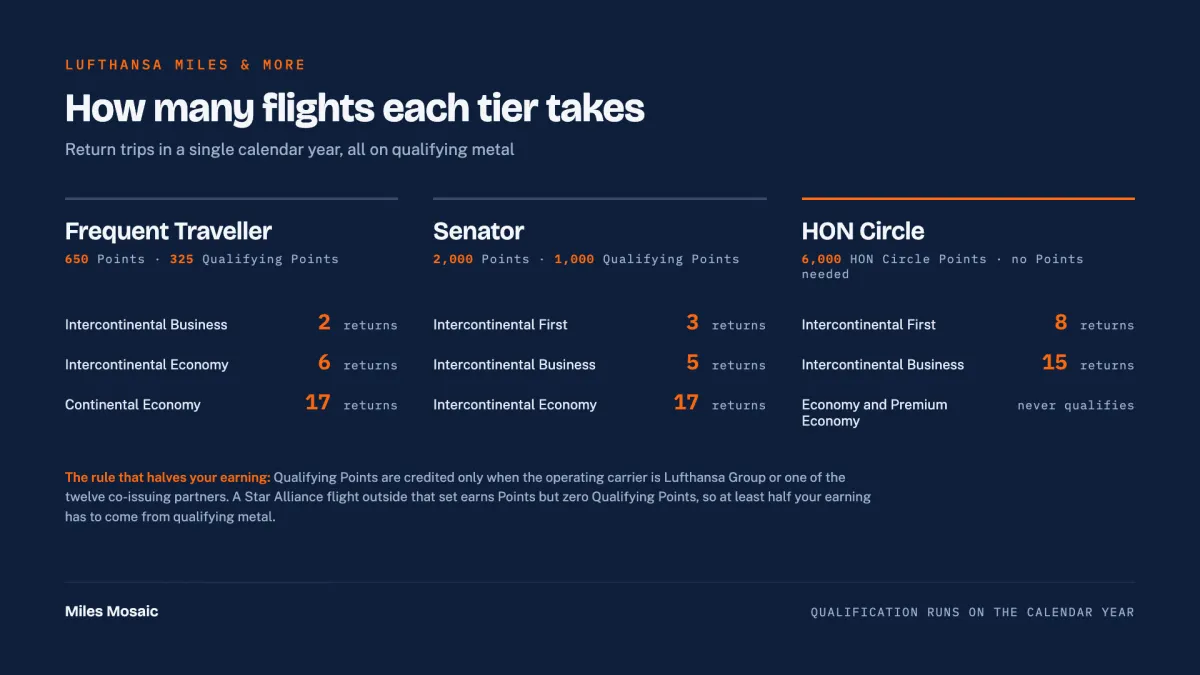
Miles & More asks for 650 Points and 325 Qualifying Points for Frequent Traveller, 2,000 and 1,000 for Senator, and 6,000 HON Circle Points for the top tier. Those numbers mean very little on their own. What matters is how many actual flights they represent, and the answer depends far more on cabin than on distance.
Miles & More is the frequent flyer programme of Lufthansa and the wider Lufthansa Group, which includes Austrian Airlines, SWISS, Brussels Airlines, ITA Airways, Eurowings and Discover Airlines. Its three tiers map onto Star Alliance like this: Frequent Traveller is Star Alliance Silver, Senator is Star Alliance Gold, and HON Circle is also Star Alliance Gold. There is no Star Alliance tier above Gold, which is why HON Circle is priced in Lufthansa Group benefits rather than alliance ones.
This is the arithmetic in flights rather than points, plus the two rules that decide whether the flying you are already doing counts at all.
Miles & More awards Points per flight segment, from a single table that applies identically to all three currencies. The numbers below, taken from the programme's own Points system page, are the same whether they are being credited as Points, Qualifying Points or HON Circle Points; what changes is which currencies a given flight earns. If the idea of three parallel counters is new to you, our guide to status currencies covers why programmes run more than one.
| Route type | Economy | Premium Economy | Business | First |
|---|---|---|---|---|
| Continental | 20 | 20 | 40 | 40 |
| Intercontinental | 60 | 80 | 200 | 400 |
Two figures in that table are routinely misread. Continental First is 40, not 400. And continental Premium Economy is 20, identical to Economy, so paying up for the cabin on a short-haul sector buys you comfort and nothing else on the status front.
Intercontinental First sits at 400 Points on the Points system page today, which makes it a clean double of Business rather than one and a half times it. Guides and forum posts written before 2026 commonly quote 300. Miles & More publishes no change log, so we cannot date the increase from the programme's own materials and this article does not try to; what is checkable is the live figure, and 400 is what the page carries.
Run the table against the requirement and the picture becomes concrete.
| How you fly | Segments needed | Return trips |
|---|---|---|
| Intercontinental Business | 4 | 2 |
| Intercontinental Premium Economy | 9 | 4 to 5 |
| Intercontinental Economy | 11 | 5 to 6 |
| Continental Business | 17 | 8 to 9 |
| Continental Economy | 33 | 16 to 17 |
Two long-haul Business returns is a realistic target for a lot of business travellers, and 33 short-haul Economy segments is a genuinely heavy year of European commuting. The gap between those two rows is the whole story of the programme: cabin dominates, and no amount of short flying substitutes for long flying at the front. Our Frequent Traveller status tracker works through the routes to that specific tier.
| How you fly | Segments needed | Return trips |
|---|---|---|
| Intercontinental First | 5 | 2 to 3 |
| Intercontinental Business | 10 | 5 |
| Intercontinental Economy | 34 | 17 |
| Continental Business | 50 | 25 |
Five long-haul Business returns in a calendar year is the honest benchmark for Senator. That is a real corporate travel pattern rather than a stretch. Seventeen long-haul Economy returns, by contrast, is not something anyone does by accident, which is why Senator is effectively a premium-cabin tier despite having no cabin requirement written into it.
This is the most commonly misreported thing about the programme, so here it is flatly. HON Circle has no Points requirement and no Qualifying Points requirement. It needs 6,000 HON Circle Points, which is a third and separate currency, and Miles & More states the split plainly: Frequent Traveller and Senator need both Points and Qualifying Points, while HON Circle needs HON Circle Points.
HON Circle Points accrue only on Business and First Class flights. Economy and Premium Economy earn none whatsoever, no matter how far you fly or how often.
| How you fly | Segments needed | Return trips |
|---|---|---|
| Intercontinental First | 15 | 7 to 8 |
| Intercontinental Business | 30 | 15 |
| Continental Business | 150 | 75 |
Fifteen long-haul Business returns in one calendar year is the practical bar, which explains why HON Circle is rare. At the current 400 Points a segment, intercontinental First reaches the same 6,000 in fifteen segments. Our HON Circle status tracker follows that count through a year and covers what the tier delivers once you hold it.
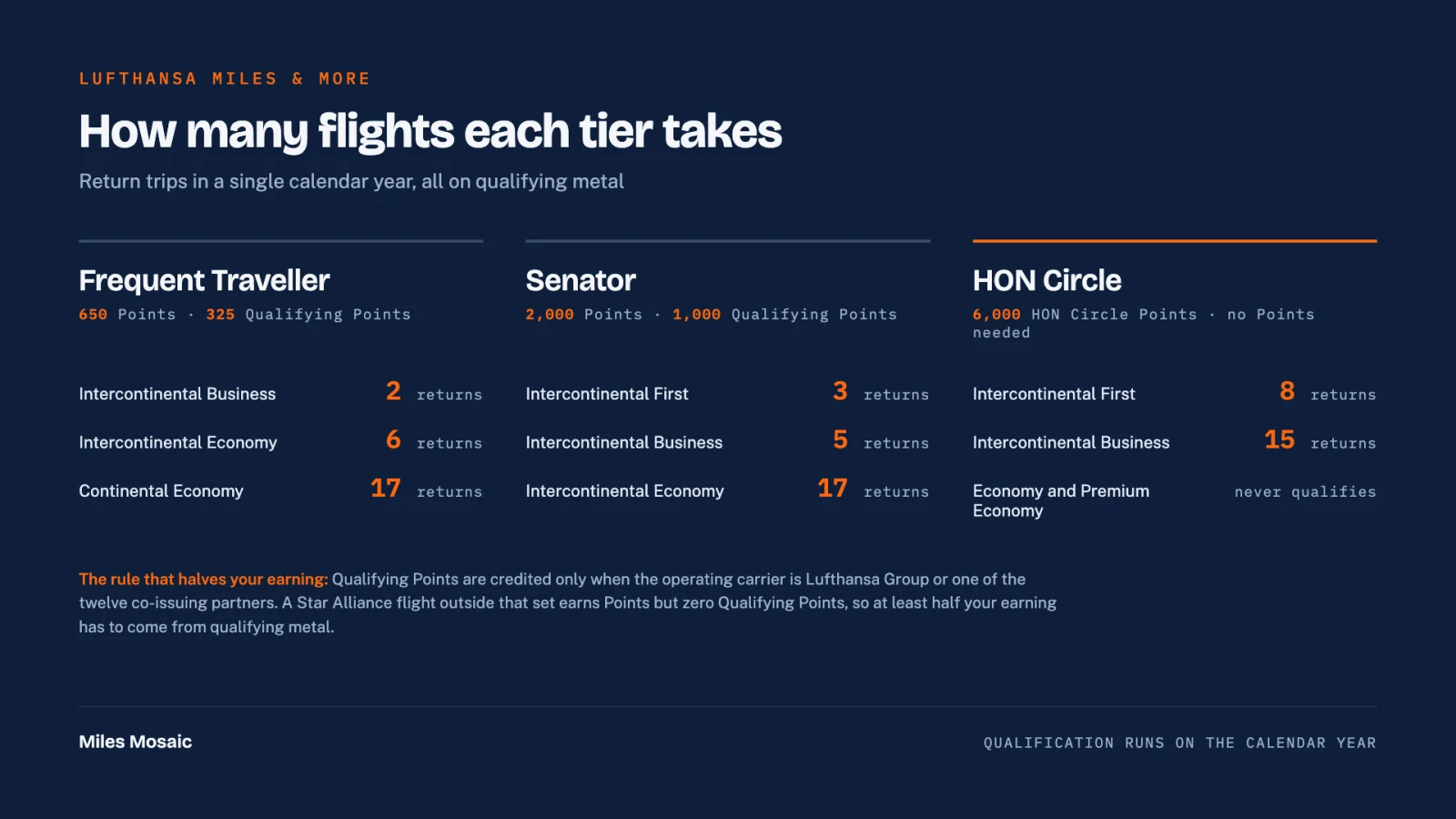
Here is the constraint most people discover too late. Points and Qualifying Points are the same per-segment number, but they are credited on different sets of airlines. The Points system page sets it out: Points are credited for flights operated by Lufthansa Group, co-issuing Miles & More partners and Star Alliance airlines, while Qualifying Points and HON Circle Points are earned only on flights operated by Lufthansa Group and co-issuing partners.
Miles & More's own worked example is Frankfurt to Bangkok in Economy on Thai Airways: 60 Points, but no Qualifying Points and no HON Circle Points. Thai is a Star Alliance member in good standing, and the flight is worth nothing towards Frequent Traveller's 325 or Senator's 1,000.
Because the Qualifying Points requirement is exactly half the Points requirement at both tiers, the rule of thumb is clean: at least half your earning must come from Lufthansa Group or co-issuing metal. The twelve co-issuing carriers are Air Dolomiti, Austrian Airlines, Brussels Airlines, Croatia Airlines, Discover Airlines, Eurowings, ITA Airways, LOT Polish Airlines, Lufthansa, Lufthansa City, Luxair and SWISS. Miles & More maintains that roster on its partner pages rather than in the Points system table, and it has changed as the group has absorbed and rebranded carriers, so check it before you credit a flight you are counting on.
Edelweiss is the awkward one. It is not among the twelve, and the Points system page does not carve it out either way. Treat an Edelweiss sector as earning Points without Qualifying Points unless the credit that lands in your account says otherwise, and do not plan a qualification year around a codeshare number.
One warning about exclusions. Miles & More states that depending on the airline, some flight numbers and booking classes may not qualify, but it publishes no master exclusion list and devolves the detail to per-partner pages. The only global exclusion it states is that award flights and some special fares earn nothing. Deeply discounted fares are the usual casualty, and the same pattern repeats across the industry; our guide to which basic fares earn miles and status covers how carriers draw that line. Check the specific partner's page rather than assuming.
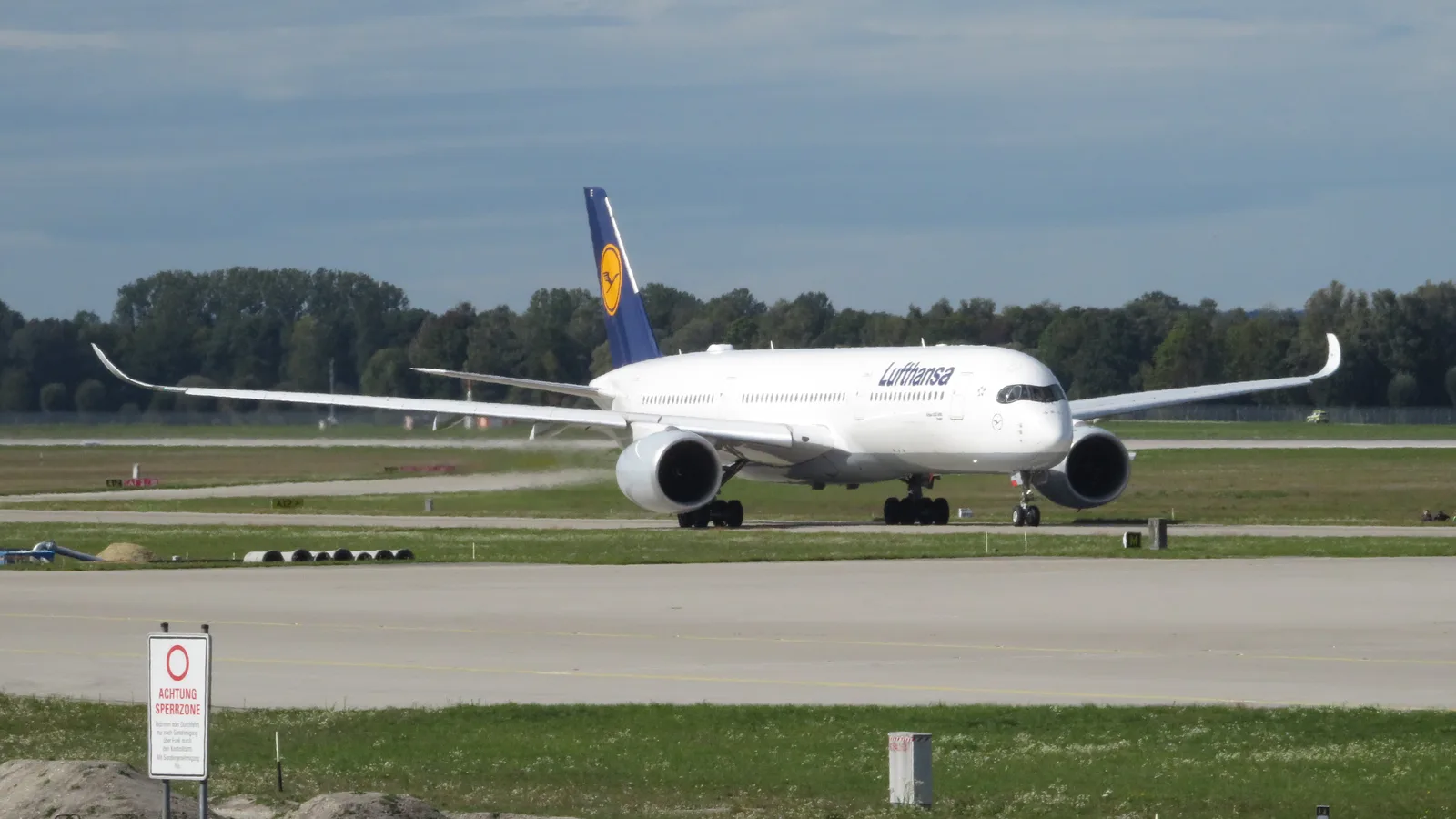
Miles & More publishes no distance bands at all. The continental versus intercontinental test is binary and purely geographic: it asks whether your departure and arrival airports sit in the same zone on a published six-zone country table, covering Europe, North and Central America, South America, Africa, the Middle East and Asia, and Australia.
The trap follows directly from where the zone lines fall. Per the country table Miles & More publishes alongside the Points system, Algeria, Egypt, Libya, Morocco and Tunisia are classified as part of the European zone, as are Turkey, Russia, Armenia, Azerbaijan and Georgia. Israel, Lebanon and Jordan are not; they sit in the Middle East and Asia zone. Six routes out of Frankfurt make the consequence obvious.
| Route from Frankfurt | Zone | Continental or intercontinental | Economy Points |
|---|---|---|---|
| Hurghada, Egypt | Europe | Continental | 20 |
| Tenerife, Spain | Europe | Continental | 20 |
| Istanbul, Turkey | Europe | Continental | 20 |
| Tel Aviv, Israel | Middle East and Asia | Intercontinental | 60 |
| Beirut, Lebanon | Middle East and Asia | Intercontinental | 60 |
| Amman, Jordan | Middle East and Asia | Intercontinental | 60 |
The practical consequence is that a longer flight can earn a third of what a shorter one does. Frankfurt to Hurghada and Frankfurt to Tenerife are both further than Frankfurt to Tel Aviv, and both earn 20 Points in Economy against Tel Aviv's 60, because only Tel Aviv crosses a zone boundary. If you have any discretion over where a trip goes, that ratio is worth knowing before you book.
Non-flight earning is more useful here than in most programmes, though the good routes are not the obvious ones. The question to ask of each one is not how many Points it pays but which of the three counters it moves, because only the Qualifying Points column decides whether you qualify.
| Route | Points | Counts as Qualifying Points? | Counts as HON Points? | Cap |
|---|---|---|---|---|
| eVoucher conversion | 50 per eVoucher | Yes, 50 | Yes, 50 | Up to four per transaction, no annual limit |
| Credit-card mile exchange | 20 to 100, by package | Yes, 20 to 100 | No | Once per calendar year, on 5,000 to 25,000 award miles |
| Green Fares and SAF contributions | Up to 80% more on the flight | Yes, the same uplift | Yes, up to 20% more | Green Fares add 20% within Europe and to North Africa, 10% intercontinental |
| Rail: Austrian AIRail, Lufthansa Express Rail, SWISS Air Rail | Yes, all three currencies | Yes | Yes | 160 Qualifying Points at Frequent Traveller, 500 at Senator, 1,000 HON Circle Points at HON |
| Lufthansa Express Bus | None | No | No | Not applicable |
| Marriott Bonvoy | 40 per qualifying stay | No | No | 120 Points per calendar year |
Read down the Qualifying Points column and the ranking falls out on its own. eVouchers are the only route that moves all three counters without a ceiling, and Miles & More's eVoucher page confirms they count towards lifetime status as well. Green Fares and rail are genuinely useful but capped or proportional. The card exchange is a once-a-year top-up that leaves HON Circle untouched, and welcome bonuses and promotional multiples are excluded from it.
Marriott Bonvoy is the one most likely to disappoint. Miles & More's own page still says stays of at least two days, but Marriott's current partner FAQ defines a qualifying stay as a single stay of at least one night, which is the live rule. The catch is that these are ordinary Points only, so the 120-point cap covers 18 per cent of Frequent Traveller's Points requirement and none of its Qualifying Points.
Qualification runs on the calendar year, and retroactive credits count towards the year the flight was taken rather than the year they land in your account. Status itself is generous once earned: it starts as soon as you achieve it and runs to the end of February the year after next, so qualifying in April 2026 buys status through to the end of February 2028. That is close to two full years from a single strong calendar year, and it is one of the better validity structures among the major European programmes. If you hold several programmes with different year ends, our qualification deadline tracker keeps the dates in one place.
There is also a rollover route that is not widely known. Miles & More's eVoucher transfer and exchange page sets it out: Senators and HON Circle Members can carry Points into the next calendar year using eVouchers, at 100 Points and 100 Qualifying Points each, with HON members also receiving 100 HON Circle Points. Only Points earned after your status renewal are eligible, and transferred Qualifying Points stop counting towards lifetime status once deducted, so it is a trade rather than free money.

The flight counts only matter if the benefits justify them, and the Star Alliance mapping does much of the work here.
Frequent Traveller maps to Star Alliance Silver, which is a thin alliance tier: priority waitlisting and standby, and not much else across partners. The value sits in the Lufthansa Group benefits underneath it, including lounge access on Lufthansa Group flights, an extra bag, and preferred seating. It is better than its alliance badge suggests, and it is the tier most people underestimate.
Senator maps to Star Alliance Gold, and that is where the badge starts doing real work. Lounge access across the alliance, priority check-in, boarding and baggage at every Star carrier, and additional baggage allowance worldwide. Within the Lufthansa Group it adds Senator lounges, guaranteed seat availability on selected fares, and free rebooking. This is the tier worth planning a year around.
HON Circle also maps to Star Alliance Gold, so the alliance benefits do not improve at all. What improves is everything inside the Lufthansa Group: the HON Circle lounges, the First Class Terminal in Frankfurt, chauffeur service, and a level of individual handling the lower tiers do not receive. It is a Lufthansa Group tier rather than an alliance one, which is why it is priced in Business and First segments.
Miles & More runs a lifetime track alongside the annual one, and it is worth knowing about because some of the same earning counts twice. Lifetime status is earned on accumulated qualifying activity over a member's whole history rather than within a calendar year, which means a long career of moderate flying can reach a permanent tier that a single heroic year cannot.
The mechanic that matters most for planning is that eVoucher conversions count towards lifetime totals as well as annual ones, while the rollover route deliberately does not: Qualifying Points transferred forward into the next calendar year stop counting towards lifetime status once they have been deducted. If lifetime status is a genuine goal rather than a curiosity, that makes rollover an actively costly choice, and it is the kind of trade-off the programme does not spell out anywhere prominent.
Frequent Traveller at two long-haul Business returns is worth having and easy to underestimate; Star Alliance Silver is thin, but the Lufthansa Group benefits underneath it are not. Senator, at five, is the tier that changes how travel feels, and for most people it is the right target if the flying is there. HON Circle rewards a travel pattern rather than a plan: if fifteen long-haul Business returns a year is not already your life, no amount of optimisation gets you there.
The planning question is always the same one, and it is not the headline threshold. It is whether the specific flights already in your calendar will clear both counters before 31 December, given how many of them are on carriers that earn Qualifying Points at all. Our free status forecaster answers that from the trips you have already booked, and Miles Mosaic tracks the split across every programme you hold, without ever asking for an account password. Our Senator status tracker goes deeper on the earning routes to that specific tier, and the complete Miles & More guide covers the award side of the programme.
See your requalification forecast in under a minute. No account, and never a loyalty password.
Forecast my status, free →Share
Last reviewed: · How we research and update
Lufthansa Miles & More 2026: the modern Points, Qualifying Points, and HON Circle system, current status thresholds, and why the programme …
Read article →Miles & More Senator in 2026: 100,000 qualifying points, Star Alliance Gold, lounge access, and a 50% earning bonus.
Read article →Miles & More Frequent Traveller in 2026: 35,000 qualifying points, Star Alliance Silver, Lufthansa Business Lounges.
Read article →When does each airline and hotel programme’s qualification year reset? A 2026 reference covering calendar-year, April–March, rolling-window…
Read article →