
oneworld Alliance: The Complete 2026 Guide
oneworld in 2026: the live 15-member roster, Ruby, Sapphire and Emerald benefits, the best frequent-flyer programmes to hold, the strongest…
Read article →Independent Miles Mosaic guide. No programme partnerships, no account linking, no scraped balances. Sources cited below; corrections welcomed.
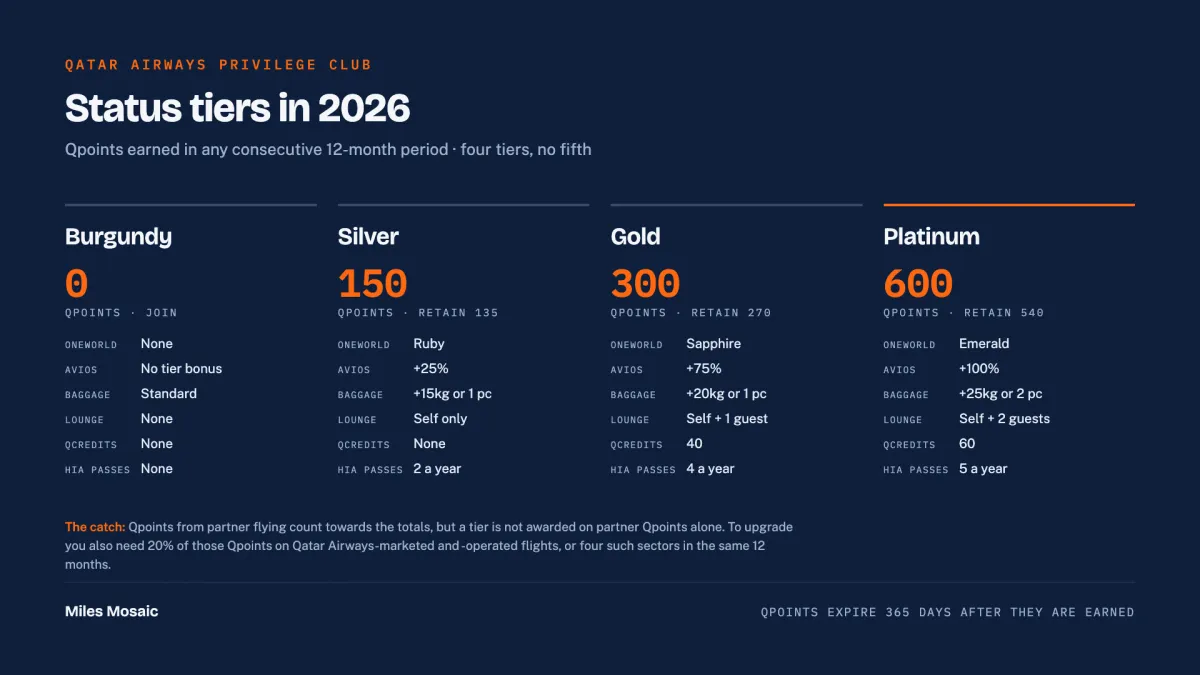
Qatar Airways Privilege Club has four tiers and one rule that decides whether most people ever reach the top three. Silver, Gold and Platinum need 135, 270 and 540 Qpoints in a rolling 12-month window. The rule that decides most cases is that partner Qpoints count towards those totals but will not, on their own, earn you the tier.
Those thresholds are currently discounted, a promotional window that ends on 30 November 2026, after which Silver, Gold and Platinum rise to 150, 300 and 600 Qpoints from 1 December 2026.
The alliance mapping is the short version of what each tier is worth: Qatar Silver is oneworld Ruby, Qatar Gold is oneworld Sapphire, and Qatar Platinum is oneworld Emerald. Burgundy, the entry level, carries no oneworld status at all. Gold is the tier that unlocks alliance-wide lounge access and priority handling, which is why it is the one most people should aim at.
This is how the programme works in 2026: the thresholds, the retention arithmetic, the Qatar-flown requirement, and what each tier is actually worth once you get there.
| Tier | Qpoints to attain | Qpoints to retain | oneworld | Avios tier bonus |
|---|---|---|---|---|
| Burgundy | Join | Not applicable | None | None |
| Silver | 135 | 110 over 12 months, or 270 over 24 | Ruby | 25% |
| Gold | 270 | 225 over 12 months, or 540 over 24 | Sapphire | 75% |
| Platinum | 540 | 450 over 12 months, or 1,080 over 24 | Emerald | 100% |
There is no fifth tier. Privilege Club's terms are explicit that the programme has four membership tiers, and it has no lifetime status. If you have seen a Platinum One or a lifetime Platinum referenced somewhere, that guide has confused Privilege Club with another oneworld programme.
Qualification runs on a genuinely rolling window rather than a membership year or a calendar year. You move up whenever you have earned enough Qpoints in any consecutive 12-month period. The mechanism that makes it roll is that Qpoints themselves expire 365 days after they are earned, so old earnings drop off the back of your total as new ones arrive. Miss retention and you drop one tier; go 24 months with no account activity at all and you go straight back to Burgundy. That rolling structure is unusual, and our elite status qualification calendar sets out how it compares with the fixed-year programmes.
Here is the part that is easy to read past and expensive to get wrong. Qpoints earned on oneworld partners count towards the thresholds above, but a tier is not awarded on partner Qpoints alone. There is a separate Qatar-flown requirement layered on top, and it works differently for upgrading than for retaining.
| Action | 20% Qatar-flown test | Alternative 1 | Alternative 2 |
|---|---|---|---|
| Upgrade a tier | At least 20% of the Qpoints you earned must come from flights marketed and operated by Qatar Airways | At least 4 such sectors during the same 12-month period | None. The 24-month path does not exist for upgrades |
| Retain a tier | The same 20% test | At least 4 such sectors within the last 12 months | At least 8 such sectors within the last 24 months |
Qatar sets the upgrade limb out on its Qpoints earning page: at least 20 per cent of the Qpoints you earned, or at least four Qatar-marketed and -operated sectors in the same 12-month period. Most summaries collapse the two columns into a single rule with three options, which overstates what is available when you are trying to move up. The eight-sectors-in-24-months path exists only for retention, and if retention is your concern our guide to keeping airline elite status covers the same trade-off across other programmes.
Two further points of precision matter here. The 20 per cent is calculated on the Qpoints you actually earned, not on the tier threshold, so a member who overshoots needs proportionally more Qatar flying, not less. And Qatar's own terms define a sector as a single origin-to-destination hop, with London to Doha to Bangkok given as a worked example of two sectors. That is more generous than it first sounds: a return trip that connects through Doha to somewhere beyond gives you four sectors and satisfies the alternative limb outright. A simple return to Doha itself is only two.
Qatar's own pages are not perfectly consistent about this, using "flights" in one place and "sectors" in another, and attaching the requirement to renewal only in the terms while the tier page attaches it to qualification as well. The Qpoints earning page linked above is the most specific and is the one to work from. We use "sectors" throughout, since that is what the terms actually define.
Privilege Club does not use distance and it does not use spend. Qpoints are awarded according to the booking class of the marketing carrier, on the fare you purchased rather than the cabin you ended up flying in. An operational upgrade earns you nothing extra; a deeply discounted business fare earns less than a flexible one.
Qatar publishes no Qpoints chart. There is a calculator on the site and nothing else, which is why the worked examples circulating on third-party sites disagree with each other by wide margins, sometimes by a factor of eight. If you need a figure for a specific fare, price it in Qatar's own calculator rather than trusting a table you found elsewhere. That is a genuine transparency gap, and it makes forward planning harder than in programmes that publish a chart, a point we cover more generally in our guide to status currencies.
On the ground, Qatar's Qpoints earning page puts Qatar Duty Free purchases and Qatar Airways Holidays packages at 1 Qpoint per US$100 spent. That is a slow route to a tier, and Head for Points reports an annual cap on non-flying Qpoints, though Qatar does not publish that cap itself. Treat ground earning as a top-up rather than a strategy.
One earning boundary is worth stating clearly. Qpoints accrue on Qatar Airways and on oneworld carriers. Qatar's various non-oneworld partners earn Avios but no Qpoints at all, so crediting them will build a redemption balance without moving you a single step towards status.

| Benefit | Burgundy | Silver | Gold | Platinum |
|---|---|---|---|---|
| Avios tier bonus | None | 25% | 75% | 100% |
| Extra baggage | Fare allowance only | 15 kg or 1 extra piece | 20 kg or 1 extra piece | 25 kg or 2 extra pieces |
| Lounge access and guests | None | Member only, no guest | Member plus 1 guest | Member plus 2 guests |
| Priority check-in | No | Yes | Yes | Yes |
| Seat selection | 10% discount | 20% discount | Complimentary | Complimentary |
| Guaranteed Economy seat | No | No | Yes | Yes |
| Award change and cancellation fees | Payable | Payable | Waived | Waived |
| Qcredits a year | None | None | 40 | 60 |
| Al Maha meet and assist | No | No | Member plus 1 guest | Member plus 2 guests |
| Hamad International guest passes a year | None | 2 | 4 | 5 |
| Avios expiry exemption | No | No | No | Yes, while the tier is held |
Three things in that table repay a second look. Priority stand-by is available at every tier including Burgundy, which is unusual. At Gold a cluster of benefits switches on together rather than one at a time: complimentary seat selection, the guaranteed Economy seat, priority baggage handling, waived award change and cancellation fees, better award availability and a Priority Services line at the contact centre. And the jump from Gold to Platinum is smaller than the jump from Silver to Gold on almost every row, which is the practical case for treating Gold as the target.
Priority check-in is not flat at Hamad International. There it is tiered by cabin: Al Safwa counters in First, Al Mourjan counters in Business, and Row 3 in Economy. Everywhere else, Silver and above use Business counters regardless of the cabin flown. Silver members can also nominate up to two Travel Coordinators, which is a small administrative benefit that never appears in tier comparisons.
Two things do not exist that are frequently attributed to Privilege Club. There are no Platinum status nominations and there are no upgrade vouchers. The upgrade currency is Qcredits, which can be spent on cabin upgrades or on excess baggage. And two Platinum perks, the personalised membership card and personalised baggage tags, are currently marked suspended until further notice on Qatar's own benefits page, which is a live gap between the marketing and the reality.
A note on lounges, because it is the single most misunderstood benefit. Qatar's member benefits page sets lounge access out by tier and by cabin rather than as a flat status perk. Al Mourjan is reached through the cabin you are flying, as the Qatar Airways and oneworld First and Business lounge at Doha. A Gold or Platinum member flying Economy through Doha uses the separate Platinum and Gold lounges instead. Plan on that basis rather than on the alliance benefit table, and if you want to check what a specific tier and cabin combination opens at a specific airport, our lounge access tool answers exactly that question.
Privilege Club has run on Avios since 2022, and Qpoints and Avios are earned separately on the same flight under different rules. Avios earning depends on booking class and on your tier; the tier bonus is calculated on distance actually flown and applies only to Qatar-marketed and -operated flights. If you are weighing Avios against the other big Asia-Pacific currencies, our comparison of KrisFlyer, Asia Miles and Avios covers where each one is strongest.
Avios expire 36 months after your last accrual or redemption, and any qualifying activity resets the clock. The detail most guides omit is what happens next: after expiry there is a one-year window in which Avios can be revalidated on payment of a non-refundable fee, so an expired balance is not immediately gone. Platinum members are exempt from expiry entirely while they hold the tier. Our points expiry tracker keeps those clocks in one place if you hold balances in more than one Avios programme.
Sharing works differently from the household pools people expect. Family Members' Avios are added to the Main Member's account only after travel is completed, and the Main Member keeps sole authority to redeem them. It is one-way accrual into one account rather than a pool. Qpoints do not share at all: only Main Members earn them and they are not transferable, so a family arrangement builds one person's redemption balance and one person's status, not everyone's.
Cross-programme, Avios move between the Avios programmes, but Privilege Club's terms allow a direct link only to British Airways Club. Reaching Iberia Plus, Finnair Plus or Aer Lingus AerClub therefore means a two-hop transfer via British Airways. Accounts must be at least 30 days old, personal details must match, and the link cannot be undone once made. British Airways is also the programme whose own earning rules have moved most recently, which our coverage of the 2026 British Airways Club and Amex earning changes goes through.
The significant change was a redemption restriction rather than a status one. From 16 June 2026, Privilege Club limited who members could redeem Avios for, to a defined list of family, friends and named account holders. It proved unpopular and was partially reversed on 21 July 2026: Gold and Platinum members can now book for anyone through the call centre, with online booking returning from the end of August 2026. Silver and Burgundy members remain restricted. The original restriction was first reported by The MileLion on 22 June 2026.
One thing this guide will not do is repeat the reduced qualification thresholds circulating for tier expiries in the second half of 2026. They trace to a member email reproduced by a single outlet, we could not corroborate them, and nothing on Qatar's own pages confirms them. Publishing numbers you might plan a year around on that basis would be worse than publishing nothing. If your tier expires between now and the end of the year, read the thresholds shown in your own Privilege Club account and check them against Qatar's current terms, and treat any figure you find elsewhere as unconfirmed until it appears in one of those two places.
For anyone whose long-haul flying routes through Doha, yes, and Gold is the target. 270 Qpoints is a moderate bar, oneworld Sapphire is a genuinely useful alliance currency, and the benefit set at Gold is where the programme stops feeling thin. Our oneworld guide covers what Sapphire and Emerald get you across the rest of the alliance.
For anyone crediting mostly partner flying, be honest about the Qatar-flown requirement before you commit. Four Qatar sectors a year is one return trip through Doha, which is achievable for a lot of people. If it is not achievable for you, the Qpoints you accumulate on partners will sit there without ever converting into a tier, and a different oneworld programme will serve you better. Whether the flying you have already booked clears a threshold you care about is what our free status forecaster is built to answer, and Miles Mosaic tracks status and balances across programmes without ever asking for an account password.
See your requalification forecast in under a minute. No account, and never a loyalty password.
Forecast my status, free →Share
Last reviewed: · How we research and update
oneworld in 2026: the live 15-member roster, Ruby, Sapphire and Emerald benefits, the best frequent-flyer programmes to hold, the strongest…
Read article →A plain-English guide to every major airline and hotel status currency: what Tier Points, MQDs, PQPs, XP and Loyalty Points are, how each i…
Read article →A practical 2026 playbook for renewing airline elite status efficiently: audit your standing, forecast from booked trips, credit partner fl…
Read article →When does each airline and hotel programme’s qualification year reset? A 2026 reference covering calendar-year, April–March, rolling-window…
Read article →