Hotel Elite Nights Explained: How Bonvoy, Hilton, Hyatt and IHG Count Qualifying Nights
A plain-English guide to how Marriott Bonvoy, Hilton Honors, World of Hyatt, IHG and Accor ALL count qualifying nights for elite status in …
Read article →Independent Miles Mosaic guide. No programme partnerships, no account linking, no scraped balances. Sources cited below; corrections welcomed.
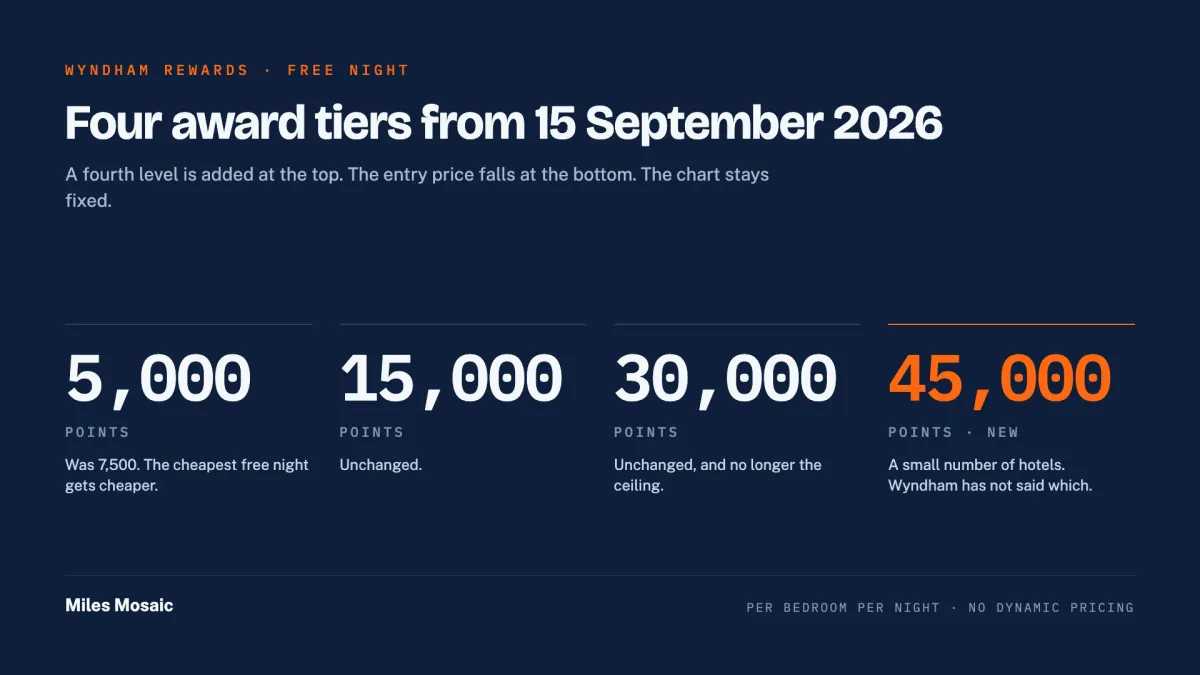
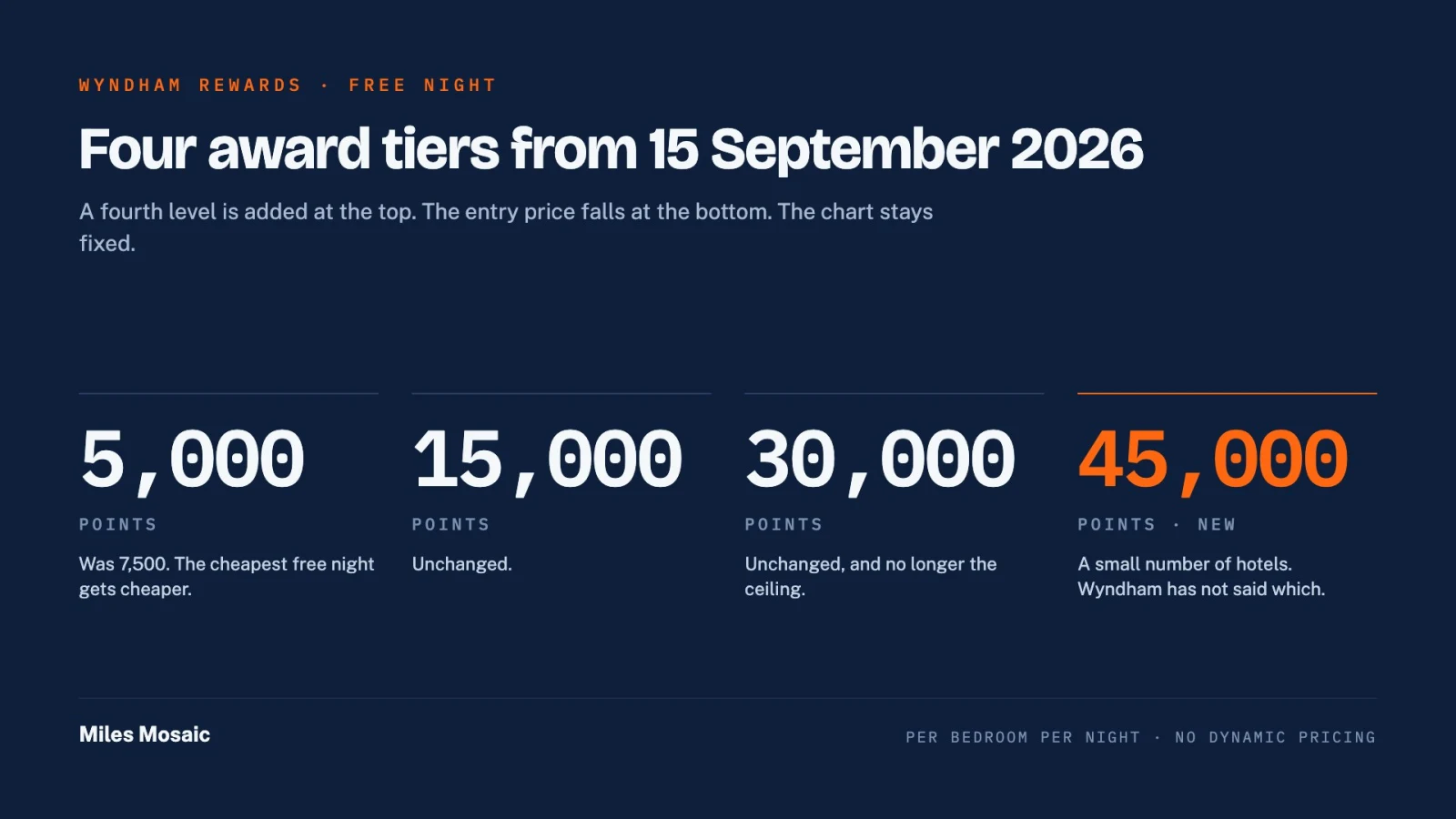
From 15 September 2026 a free night booked with Wyndham Rewards points costs 5,000, 15,000, 30,000 or 45,000 points. The programme is adding a fourth and more expensive award tier at the top, and at the same time lowering the entry price at the bottom from 7,500 points to 5,000, while keeping the fixed chart that made it worth holding.
The interesting detail is not the new tier at all. It is what Wyndham has committed to doing about bookings made before the change, which is unusually one-sided in the member's favour.
| Band | Free night until 14 Sep | Free night from 15 Sep | Points plus cash floor until 14 Sep | Points plus cash floor from 15 Sep | Net change |
|---|---|---|---|---|---|
| Entry | 7,500 points | 5,000 points | From 750 points plus cash | From 500 points plus cash | 2,500 points cheaper, a third off the old floor |
| Middle | 15,000 points | 15,000 points | From 1,500 points plus cash | From 1,500 points plus cash | Unchanged |
| Upper | 30,000 points | 30,000 points | From 3,000 points plus cash | From 3,000 points plus cash | Unchanged in price, but no longer the ceiling |
| New top | Not offered | 45,000 points | Not offered | From 4,500 points plus cash | New level, 50% above the old ceiling |
Read the two halves of that table against each other and two things happen at once. A fourth level appears at 45,000 points, above the old ceiling of 30,000. And the entry price drops: on the programme's own reward tier updates page the cheapest free night falls from 7,500 points to 5,000, with the points-plus-cash floor going from 750 points to 500. The two middle levels are the ones Wyndham leaves alone, which is why the change reads so differently depending on where your usual hotel sits.
Wyndham describes hotels as being redistributed across all four levels, some moving down and some moving up, with the vast majority spanning the 5,000, 15,000 and 30,000 point levels. So this is not a straightforward increase. It is a wider chart, with more room at both ends.
One structural detail is easy to miss because Wyndham does not draw attention to it. The points-plus-cash entry point sits at exactly 10% of the free-night price at every level: 500 against 5,000, 1,500 against 15,000, 3,000 against 30,000 and 4,500 against 45,000. That was also true of the outgoing chart, where 750 points sat against a 7,500-point free night. The ratio is unchanged, which means the points-plus-cash floors are not a separate decision. They move automatically with whatever tier a hotel lands in, and there is no tier where the discounted option is proportionally better value in points than any other.
Wyndham's phrasing is doing real work and deserves unpacking, because it is the difference between this being a devaluation and a rebalancing.
Three of the four levels are the ones that already existed, and Wyndham says most hotels land in them. The new 45,000 level is described as covering a small number of properties. Taken at face value, that means the typical member's experience of 15 September is either no change at all, or a fall from 7,500 to 5,000 at the cheapest properties. The increase is concentrated at the top of the estate.
But the same sentence contains the warning. "Some lower, some higher" applies to the existing levels too, so a hotel that costs 15,000 points today could be 30,000 in September without ever touching the new tier. Nothing in the announcement rules that out, and there is no published list to check it against. The change that matters to you personally is not the headline 45,000 number. It is whichever of the four bands your usual hotel lands in, and Wyndham has not told you. That pattern, a change announced in aggregate and delivered property by property, is the ordinary shape of a hotel repricing, and our guide to surviving devaluations covers how to hold a balance through one.
Wyndham has kept the part that makes the programme worth holding. It describes the new structure as a simple, fixed redemption structure with "no dynamic pricing or increases based on seasonality".
That matters, because the reflex assumption whenever a hotel chart changes is that fixed pricing is being abandoned. Marriott Bonvoy prices awards variably, and Hilton Honors has run on demand-based award pricing for years. World of Hyatt went the other way: Hyatt's own award chart update notice took it from three redemption levels per category to five on 20 May 2026 while keeping a published chart. Wyndham going from three levels to four puts it in the same territory as Hyatt: more granular, still predictable. IHG One Rewards sits at the other end of that spectrum again, with no chart to read at all.
A fixed chart is the one kind of hotel currency you can plan a year ahead with any confidence. Adding a level makes the plan slightly harder without breaking it, which is a meaningfully different thing from moving to demand-based pricing. If you want to see how often the major programmes actually move their pricing, our devaluation tracker records the dated changes rather than the rumours.
Here is the part that deserves more attention than it has had.
Wyndham says points bookings made before 15 September will be honoured at the current rate. There is nothing unusual in that; most programmes protect existing reservations. But Wyndham has also committed to the other direction: if a booking made before the update drops in rate, the difference in points is returned automatically. Cancellation still follows the hotel's own policy, with points redeposited.
So for a stay you were reasonably likely to take anyway, booking before 15 September has no downside from the chart change itself. If your property moves up, you paid the old price. If it moves down, the difference comes back without you asking for it. The only real risks are the ordinary ones: that your plans change, or that you tie up a balance you would rather have kept liquid.
Two caveats before anyone books a wall of speculative nights. Wyndham's wording covers bookings made with points, and it does not say explicitly whether the automatic refund extends to the points-plus-cash tiers, so do not assume it on a discounted-night booking. And a rate lock is only worth using on stays you actually intend to take. Booking as far ahead as Wyndham's calendar allows in the hope of arbitrage is a good way to end up holding reservations you then have to unwind.
The decision is simpler than it looks, and it comes down to two questions asked in order. Is this a stay you would book anyway in the next several months? If not, stop; the guarantee is not a reason to create a booking. If yes, is the property one you would expect to sit at the top of Wyndham's estate? If it is, book before 15 September, because that is where the increase is concentrated and the lock is worth the most. If it is a midscale property, booking early costs you nothing and might quietly refund you points in September.
What the guarantee does not do is protect the value of points you are still holding. A rate lock applies to a reservation, not to a balance. If your plan is to sit on a balance and decide later, the chart change reaches you in full, and no amount of pre-September activity changes that.
The question most readers will arrive with is which hotels cost 45,000 points. Wyndham has not said.
There is no property-level tier list on the update page, and the resort names circulating in secondary coverage are not confirmed by Wyndham, so they do not appear here. Until that list exists, the honest answer is that you can identify your own property's new price only by pricing a stay after 15 September, once the chart goes live. Our award price tracker is the place to check what a night actually costs once it does.
There is a related trap. As of 6 August 2026, Wyndham's own terms and conditions page still presented free nights as starting at 7,500 points and discounted nights at 750 points plus cash. Anyone who checks the rules rather than the announcement will find the outgoing chart. That is a lag in Wyndham's documentation rather than a contradiction of the announcement, but it is the kind of thing to know before a conversation with a front desk, and it is worth re-checking in mid-September.
This is a global change and it lands unevenly. One caveat governs the whole section: Wyndham has published no brand-to-band mapping, so the grouping below is by where each brand sits on rate, not by anything the programme has confirmed.
| Segment | Typical brands | Likely band | Net effect |
|---|---|---|---|
| Economy and midscale | Days Inn, Super 8, Microtel, Travelodge | Not published by Wyndham. Its own wording puts the vast majority of hotels across the 5,000, 15,000 and 30,000 levels | Gain. The floor falls from 7,500 to 5,000, a third off the cheapest redemption |
| Upscale | Wyndham Garden, Ramada | Not published by Wyndham | Mixed. These are the properties most exposed to a move between the three existing levels in either direction |
| Resorts | Not named by Wyndham | Not published by Wyndham. The 45,000 level is described as covering a small number of properties | Loss. This is where a ceiling 50% above the old one bites |
The gainers are anyone whose usual Wyndham stays are at the economy and midscale end, which is most of the estate. A floor of 5,000 points instead of 7,500 is a third off the cheapest redemption, and Wyndham says the majority of its hotels sit in the lower three bands.
The losers are resort bookers. A 45,000-point night is 50% more than the old ceiling, and the properties most likely to sit there are the high-rate leisure resorts where a flat 30,000-point cap has quietly been one of the better deals in hotel loyalty. Wyndham has not named them, but a fixed ceiling is always worth most where cash rates are highest, and that is precisely where a new ceiling does the most damage.
For Asia-Pacific readers this is, honestly, a minor change. Wyndham's regional estate is thin and concentrated in the brands that sit at the lower end of the chart, which means the region is more likely to benefit from the lower floor than to be hurt by the new ceiling. There is no Singapore-specific angle here and it would be a stretch to invent one. The reason to read this is a points balance, not a postcode.
That is also the honest limit of what a chart tells you. Whether 5,000 points is worth spending depends on the cash rate it displaces and on what else you hold, which is the arithmetic our guide to a good cents-per-point redemption works through. Seeing it in one view across programmes is easy to lose track of across seven separate hotel logins. It is the job a tracker like Miles Mosaic does, and Wyndham Rewards is one of the 31 airline and hotel programmes it covers. The same point applies to qualification: what a night is worth is a separate question from whether it counts as a qualifying night, and the two are routinely conflated.
Programmes rarely publish a change where the member's risk runs in only one direction. Wyndham has, for about six weeks.
See your requalification forecast in under a minute. No account, and never a loyalty password.
Forecast my status, free →Share
Last reviewed: · How we research and update
A plain-English guide to how Marriott Bonvoy, Hilton Honors, World of Hyatt, IHG and Accor ALL count qualifying nights for elite status in …
Read article →World of Hyatt tiers for 2026: nights and points for Discoverist, Explorist and Globalist, milestone rewards, and what the May 2026 five-le…
Read article →Marriott Bonvoy in 2026: elite tiers, variable award pricing, PointSavers, Cash + Points, Stay for 5 Pay for 4, and when the programme dese…
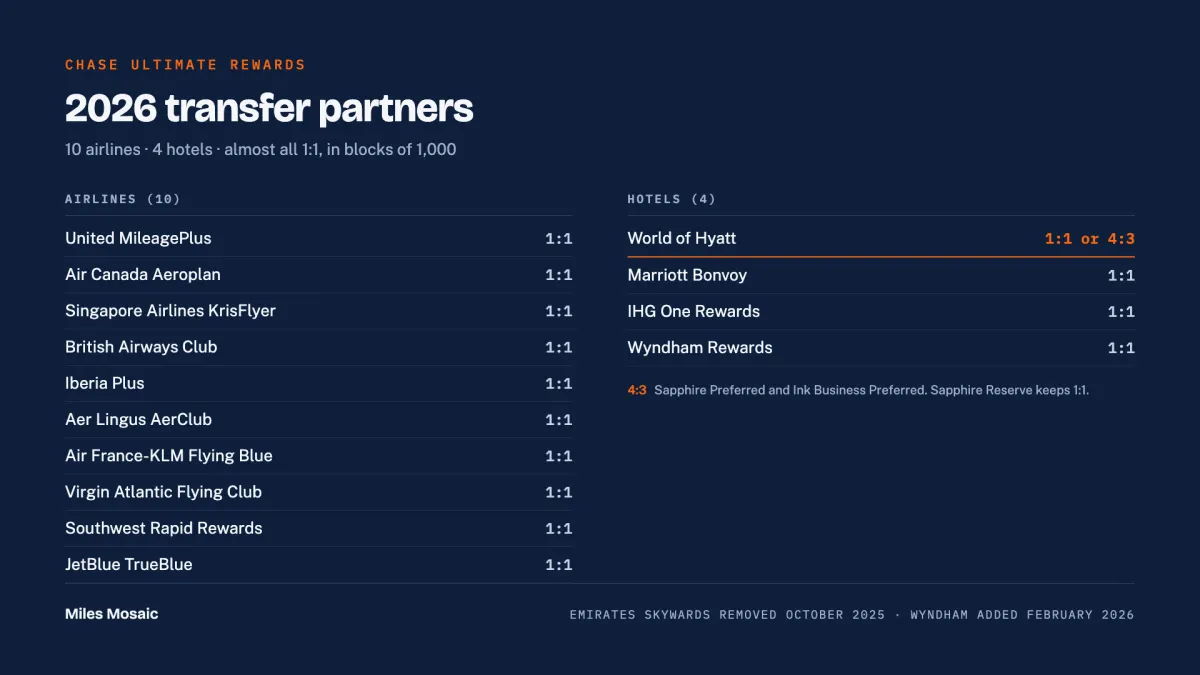
Read article →Chase Ultimate Rewards has 14 transfer partners in 2026: 10 airlines, 4 hotels, every ratio and transfer time, and the World of Hyatt 4:3 s…
Read article →