Subscription Loyalty Programs in 2026
A 2026 guide to paid travel memberships: ALL Accor+ Explorer, InterContinental Ambassador, and the wider subscription trend across airlines…
Read article →Independent Miles Mosaic guide. No programme partnerships, no account linking, no scraped balances. Sources cited below; corrections welcomed.

Accor is raising the price of Accor+ Explorer, its paid hotel membership, on Thursday 1 October 2026, and has published the new figure for ten markets. Existing members who have auto-renewal switched on by 30 September, and who keep it on through their renewal payment, hold the current price for one more membership year.
Updated 15 September 2026: every fee in the table below, the price-lock wording and the terms clauses cited were re-checked against Accor's own pages on 15 September 2026 and are unchanged.
Two dates, then, not one. Most coverage of this change has reported the first and skipped the second, and the second is the one you can act on.
The rest of this piece is about what you would be paying for, because the more consequential change to this membership is not the fee. It is what the current terms say the benefits cover, which is less than the marketing around them suggests.
Accor set these out in a help-centre article, "Membership price: what's changing", shown as updated on 3 September 2026. The percentage column is ours, computed from the two figures either side of it.
| Market | Current | From 1 October 2026 | Change |
|---|---|---|---|
| Australia | AU$349 | AU$369 | +5.7% |
| New Zealand | NZ$379 | NZ$399 | +5.3% |
| Singapore | S$299 | S$329 | +10.0% |
| Hong Kong | HK$1,788 | HK$1,999 | +11.8% |
| Thailand | THB 7,299 | THB 7,990 | +9.5% |
| Malaysia | MYR 949 | MYR 999 | +5.3% |
| Philippines | PHP 12,499 | PHP 14,299 | +14.4% |
| Indonesia | IDR 3,599,000 | IDR 3,999,000 | +11.1% |
| Vietnam | VND 5,899,000 | VND 6,399,000 | +8.5% |
| Rest of World, including the UAE | US$249 | US$255 | +2.4% |
The spread is the thing worth noticing. The Philippines rises by 14.4 per cent, Hong Kong by 11.8, Indonesia by 11.1, Singapore by 10. The undifferentiated Rest of World band rises by 2.4 per cent. Whatever is driving this, it is not a uniform global adjustment. The steepest nominal rises land in South-East Asia and Hong Kong, though a percentage applied to a local fee is not the same thing as a comparison of what members in each market actually pay in real terms, and Accor publishes nothing about how it set them.
Read the table as ten published figures rather than ten affected markets. Each of Accor's ten panels opens by saying the fee will increase "across all markets", while the page's own introduction says "in some markets". Two markets with their own local checkout have no published new price at all: Accor's India page showed INR 19,499 a year and its Japan page 39,800 yen when both were checked on 15 September 2026, and neither market appears anywhere in the announcement. Korea and Fiji are a different puzzle. Accor's Korea page and its Fiji page both showed US$249 a year on the same date, so both route to the Rest of World product, and yet Accor describes that band as countries outside Asia-Pacific, which neither of them is. None of that is resolvable from what Accor has published, so if you buy in one of those four markets, ask before 1 October rather than after.
Accor's instruction is short and has two parts. You need to be on auto-renewal by 30 September 2026 and keep it active through your renewal payment date. Both conditions, or the lock does not apply.
Four things are worth being precise about, because the coverage has not been.
It is one year, not indefinite. Accor's phrasing throughout refers to the next membership year and the next renewal. There is no statement anywhere that the price is held beyond that single renewal. Assume you pay the new rate the year after.
It is framed for existing members. The new fee applies from 1 October for new memberships and for eligible renewals, and the fullest statement of the lock opens "If you're an existing member". Not every help-centre article repeats that qualifier, but none extends the lock to someone joining now, and Accor has published nothing about what a member who joins in September pays in September 2027.
Switching auto-renewal off breaks it. Accor does not say this in so many words, but it follows from a condition that requires auto-renewal to remain active through the payment date. If you turn it off and renew manually later, you renew at whatever the price is then. The cancellation window, per the terms, is no later than two business days before the payment date. Note that the help centre still says 48 hours in one place, and the terms are the more recent document.
The lock is not in the terms and conditions. This is the part worth knowing. The current ALL Accor+ Explorer terms are dated 19 May 2026. Clause 3 governs automatic renewal in detail and contains no price guarantee of any kind, while clause 12 reserves Accor's right to vary those terms, including the benefits, on reasonable notice. The price lock exists in help-centre articles dated between 1 and 3 September 2026, and nowhere else.
That is not a reason to distrust it. Companies honour help-centre commitments routinely, and there is no suggestion Accor will not. It is a reason to switch auto-renewal on rather than relying on a plan to renew manually at the old rate, and a reason to keep a screenshot.
To turn it on: log in, go to Profile, find the subscription-renewal setting, and toggle it on. The help centre labels the same control two different ways in two different articles, one calling it "Subscription Renewal" and the other "Auto Renewal", so look for either. On reminders, Accor is not consistent with itself: one help-centre article says reminders go out 30 and 15 days before renewal, while clause 3.3(a) of the terms and a second help article describe a single email around 30 days before the payment date. Do not rely on the second reminder existing.
Accor+ Explorer is now the only retail Accor Plus product. Accor's help centre puts the switchover at 1 October 2025: after that date an Explorer Plus member coming up for renewal could only renew into Explorer. Its fee is rising on the first anniversary of that consolidation, and because there are no other retail tiers, the rise applies to the whole programme rather than to a subset of it.
For the money, Accor's membership page and its terms describe:
One caution if you are comparing pages. Accor's own site gives the hotel count as both 4,000-plus and 5,000-plus in different places, and the membership page claims benefits at more than 30 brands while listing 25 of them by name. The participating-country count is 20 on one page, more than 20 on a second and 22 on a third. Treat any such figure as marketing rather than as specification.
This is the part that has gone largely unreported, and it matters more to the value of the membership than the fee does. The governing document is dated 19 May 2026, and two of its conditions are material enough to change the arithmetic.
Inclusions on the paid night do not extend to the free night. Clause 6.2(b) is explicit: the free night covers standard entry-level room-only accommodation, exclusive of meals, beverages and other package inclusions, and where the paid night includes such inclusions they will not be extended to the complimentary night. If you book a rate with breakfast for two, you are getting breakfast on one night, not two. On a typical Asia-Pacific rate that is a real subtraction from the benefit's value, and it applies before the fee goes up.
The most expensive night is not the one you think. Clause 6.2(c) applies the free night to the most expensive night of the stay for which the benefit is available at the time of booking, not, as most people assume, the most expensive night of the booking. If your priciest night is blacked out, the benefit falls back to the next most expensive one down.
Six further conditions sit alongside them. The free night is explicitly subject to revenue-managed availability and blackout dates, with availability not guaranteed for specific hotels or dates. One free night applies per stay, with consecutive nights at one hotel across multiple reservations counted as a single stay and parallel bookings prohibited, on pain of cancellation. A named list of rate types cannot be combined with the free night, including bookings made through online travel agents, group rates, industry and friends-and-family rates, and anything combined with a points redemption or a suite-night upgrade. Cancellation on member-rate bookings follows the rate's own rules rather than a fixed policy. Dining discounts exclude room service, the mini-bar, meeting rooms, children's menus and takeaway. And the auto-renewal cancellation window is two business days, not the 48 hours the help centre still quotes in one place.
A note on how to read all that. This article does not claim each of those conditions is new, because the previous terms document was not retrieved and read side by side, and the current document's own benefit summary is headed "as of 1 October 2025". What can be said is that this is what the governing terms provide today, on the eve of a price rise. To be fair to Accor, the marketing is incomplete rather than silent: the membership page links to both variations pages from its own navigation, and it says terms and conditions apply. But the two conditions above are the ones that change the arithmetic, and neither of them is on the page that sells you the membership.
Separately, the exclusion lists themselves are actively growing, and they live outside the terms document. The stay-benefit variations page was updated on 10 July 2026 and the dining-benefit variations page on 5 August 2026, and both carry visible update dates, which is, to Accor's credit, more transparency than most programmes offer about this kind of drift. Those two pages, not the terms, are where you will find the brand exclusions, the individual restaurants dropped to a lower rate, the country-by-country public-holiday blackouts, and the three-night requirement that applies at extended-stay brands and remote destinations.
Accor's own explanation for the fee rise, given in its help centre, is twofold: continued investment in Explorer, expanding the destinations, benefits and experiences available to members, while responding to increased costs over time. The second half of that is the ordinary and unarguable reason any subscription price rises, and Accor deserves credit for stating it rather than resting on the first half. Alongside it, Accor puts the return at around 1,040 Australian dollars a year in example savings for a couple and 1,630 for a family, across member rates, Red Hot Rooms, the free nights and dining. No methodology accompanies either figure: no stay count, no room rate, no restaurant spend. Neither is checkable. Accor labels them as examples, which is the right label, and they sit on the same website as the conditions above.
Here is the part that belongs to loyalty rather than to shopping, and the part that is genuinely poorly explained elsewhere.
Accor+ Explorer credits 30 Status Nights to your ALL Accor account within a day of joining, and again on each renewal. ALL Accor Gold requires 30 Status Nights. So Gold is effectively automatic, and the terms go further: Explorer members "automatically qualify for a minimum Elite Gold status and are never downgraded to Silver", provided they keep renewing. Note the condition at the end of that sentence. It is doing all the work.
If you already hold Gold, the 30 nights count towards Platinum, which needs 60. They cannot take you to Diamond, whatever a comparison page tells you. Accor's own help centre is unambiguous: Platinum needs 14,000 Status Points or 60 Status Nights, while reaching or keeping Diamond "can only be done by earning 26,000 status points". There is no nights route to the top tier.
The clock is the ordinary ALL one. Status Nights reset on 1 January, and Accor confirms that with an Explorer membership your status is reviewed at the end of each calendar year rather than at the start of your membership year, so it will not drop below its current level until 31 December. That is a genuinely member-friendly arrangement and it is worth knowing, because it is the opposite of what several third-party explainers say.
The cliff edge is somewhere else, and it is in clause 10.3. If the Explorer membership expires, your ALL Accor membership continues, your status is set by your own activity in the calendar year to that point, and then, in Accor's words, your ALL Accor status level is recalculated to exclude Status Nights awarded as part of the Explorer programme. The 30 nights are not yours to keep. They leave with the subscription, retroactively.
Which nights count towards which threshold, and when a chain strips them back out, is the part of hotel loyalty that catches people hardest, and every major programme draws the line somewhere slightly different. Our guide to how hotel elite nights are actually counted goes through the differences.
Not a question anyone can answer for you, and be sceptical of pages that try. "Is Accor Plus worth it" is a query largely answered by commission-driven content.
What can be said is what the arithmetic depends on, and where the uncertainty sits. The fee is a known number. The dining discount is straightforwardly calculable against your own restaurant spend at Accor properties, once you have allowed for the excluded categories: room service, mini-bar, children's menus and takeaway are all out. The member rate is 15 per cent, off non-promotional public rates only, so sale and package rates are out of it.
The free nights are where the modelling breaks down, and not by accident. Accor does give a scope figure, more than 1,400 hotels across Asia-Pacific and beyond, but no monetary value for the nights, no cap and no "up to" figure. What it publishes instead are the structural limits: entry-level room, room-only, revenue-managed availability, blackout dates, and availability not guaranteed for specific hotels or dates. A count of participating hotels is not the same thing as a promise that any one of them will have a night free when you want it. The benefit's ceiling is therefore set by availability control rather than by a published number, which is more restrictive than a cap would be and considerably harder to plan around. Any figure you see attached to those nights is somebody's estimate.
So the workable test is the one that ignores the free nights entirely. Add up what the dining discount and the member rate would have saved you over the past twelve months at Accor properties, on stays you would have made anyway. If that figure alone is comfortably above the new fee, the membership pays, and the free nights and the Gold status are upside. If it is not, you are betting the difference on two nights whose availability Accor explicitly declines to guarantee, and paying between 2.4 and 14.4 per cent more to do so.
That test is the same one worth applying to any paid membership that promises status as part of the package, and we set it out at more length in our piece on subscription loyalty programmes.
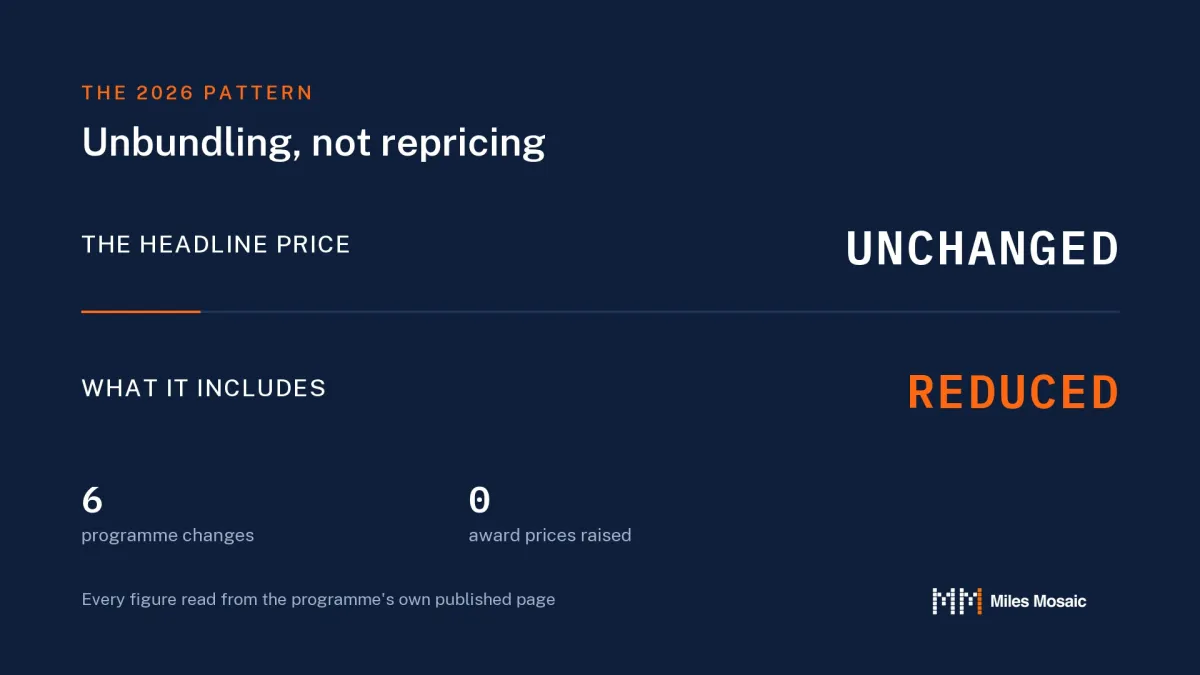
The pattern here is worth setting beside the one in our piece on unbundling as the new devaluation. There the lever is the ticket: the price holds and the inclusions shrink. Here the price moves on a published date while the conditions sit, unchanged and unremarked, in a document almost nobody opens. This article does not claim the conditions were tightened to coincide with the fee, because it has not compared the current terms with the previous version clause by clause. What it does say is narrower and checkable: the fee is rising, the conditions are more restrictive than the marketing implies, and the two facts live on the same website.
The fourth item is the one people get wrong, because it needs an answer about a year that is not finished: how many nights you have actually stayed, as distinct from how many the subscription gave you. Miles Mosaic tracks miles, points and elite status across 31 loyalty programmes, 24 airline and seven hotel, in one view, partly because a renewal date in one programme rarely lines up with anything in another, and a status cliff you have forgotten about is the expensive kind. If you are working out which deadlines apply to you at all, our round-up of programme deadlines published without their operating rules is a good place to start.
Three questions are still open and any of them could be answered before the deadline. Whether someone who joins before 1 October renews at the old price or the new one, which Accor has not addressed anywhere. What India and Japan will pay, given that both have live local prices and neither is in the announcement. And which band Korea and Fiji actually sit in, since both are sold at the Rest of World price while sitting inside the region that band excludes.
The wider pattern is worth keeping in view. A fee rise gets a dated action attached and is reported everywhere. What the benefits actually cover sits in a 21-page terms document and is reported almost nowhere. Both are on the same website, and only one of them is a story. That asymmetry is not an accident of news judgement, and it is the reason the terms are worth reading on the day you renew rather than on the day you complain.
Every fee, date and benefit condition above was checked against Accor's own pages on 15 September 2026. External sites open in a new tab.
See your requalification forecast in under a minute. No account, and never a loyalty password.
Forecast my status, free →Share
Last reviewed: · How we research and update
A 2026 guide to paid travel memberships: ALL Accor+ Explorer, InterContinental Ambassador, and the wider subscription trend across airlines…
Read article →Six loyalty changes kept a headline price or benefit name and cut what it contained. Why the usual devaluation tests miss most of them.
Read article →A plain-English guide to how Marriott Bonvoy, Hilton Honors, World of Hyatt, IHG and Accor ALL count qualifying nights for elite status in …
Read article →Four programmes have set a date members must act on and left out the operative detail. A fifth publishes its changes on a page it hides fro…
Read article →