The Devaluation That Does Not Show Up in the Award Chart
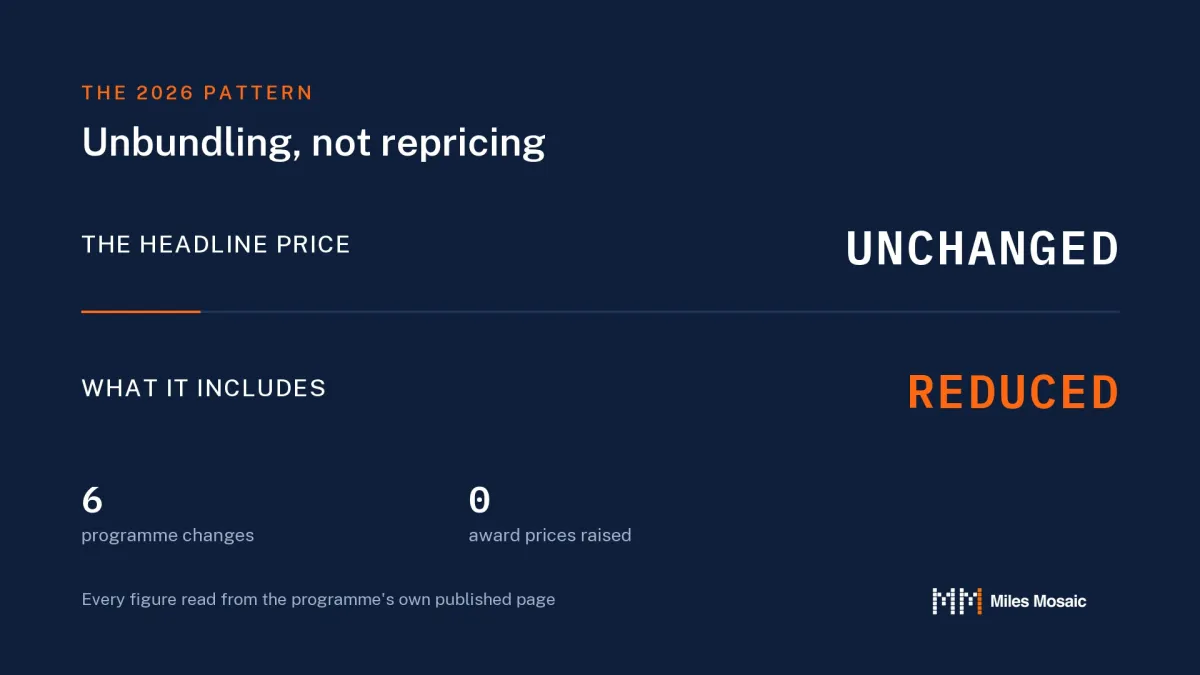
Six loyalty changes kept a headline price or benefit name and cut what it contained. Why the usual devaluation tests miss most of them.
Read article →Independent Miles Mosaic guide. No programme partnerships, no account linking, no scraped balances. Sources cited below; corrections welcomed.
Four loyalty programmes have set a date members must act on and left out an operative detail: Asiana, Wyndham Rewards, Qantas and Flying Blue. A fifth, Emirates Skywards, publishes its programme changes on a page it tells search engines to ignore. All five were checked at source on 8 September 2026.
That is a narrower complaint than it sounds, and a more useful one. The familiar version of this grievance, that programmes hide their devaluations, is mostly not what is happening. All five changes below were announced openly, several of them months ahead. What is missing is not the announcement. It is one input a member needs in order to act on the deadline: the process, the property list, the end date, the prices.
The five are not equally at fault, and this article does not treat them as though they were. Three of them, Asiana, Wyndham and Qantas, have left out an operating rule with no substitute. Flying Blue published its operating rules in unusual detail and withheld only the pricing. Emirates published everything and then made it hard to find. Those are different failures and they deserve different weight.
Every statement below about what a programme has not published means "not found on 8 September 2026, across the paths tried". Several of these could be answered any day, and one of them being answered would be the better outcome.
| Programme | Date to act on | Published | Missing |
|---|---|---|---|
| Asiana | 16 October 2026 | Asiana Club accrual on partner flights needs a post-flight request | How to make the request |
| Wyndham Rewards | 15 September 2026 | Four tiers: 5,000 / 15,000 / 30,000 / 45,000 | Which hotel sits in which tier |
| Qantas | 8 December 2026 | Rollover caps; Points Club retirement | Last day to use a Loyalty Bonus |
| Flying Blue | 8 September 2026 | Full Light, Standard and Flex inclusion tables | What any of the three fares costs in miles |
| Emirates Skywards | 1 June 2027 | New Miles expiry rule | Nothing, but the page is hidden from search |
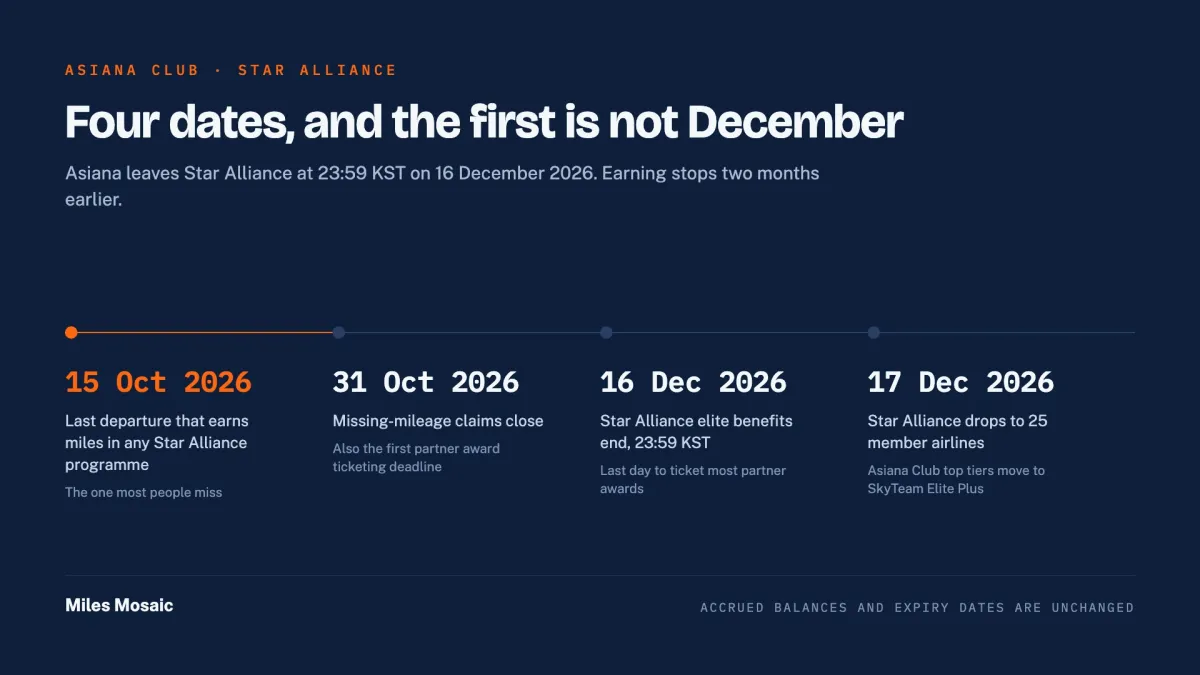
Settled. Asiana leaves Star Alliance at 23:59 Korea time on 16 December 2026, and two different things end on two different clocks. This is the part almost every summary gets wrong, so it is worth separating carefully.
Earning Star Alliance partner miles on an Asiana-operated flight stops first: Asiana’s own member notice of 23 June 2026 says you may earn partner miles on an Asiana-operated flight departing on or before 15 October 2026, and not after. Earning Asiana Club miles on a Star Alliance partner’s flight runs longer, to 16 December 2026, but changes shape in the middle: for flights departing on or before 15 October, accrual works normally and a missing-mileage claim can be filed until 31 October; for flights departing between 16 October and 16 December, the notice says accrual "is only available through a separate request after completing your flight", with automatic accrual at booking, ticketing or check-in unavailable.
Not settled. How to make that separate request.
The notice states plainly: "Details regarding the request process will be announced in a future notice." As at 8 September 2026 that notice had not appeared. The member exposed here is not the one flying Asiana. It is an Asiana Club member with a November flight booked on United, Lufthansa, Singapore Airlines or any other Star Alliance carrier. Automatic accrual on those flights stops for departures from 16 October, five and a half weeks from now, and that member has no way to know what they will need to keep afterwards: a boarding pass, a receipt, a specific form, a deadline for submitting it.
One detail is worth restating because it catches people out on both sides of the split. Every date here keys off the departure date, not the booking date. Booking early preserves nothing. There is no version of forward planning that gets around it, which is the point our full deadline-by-deadline guide to the Asiana exit spends most of its length on.
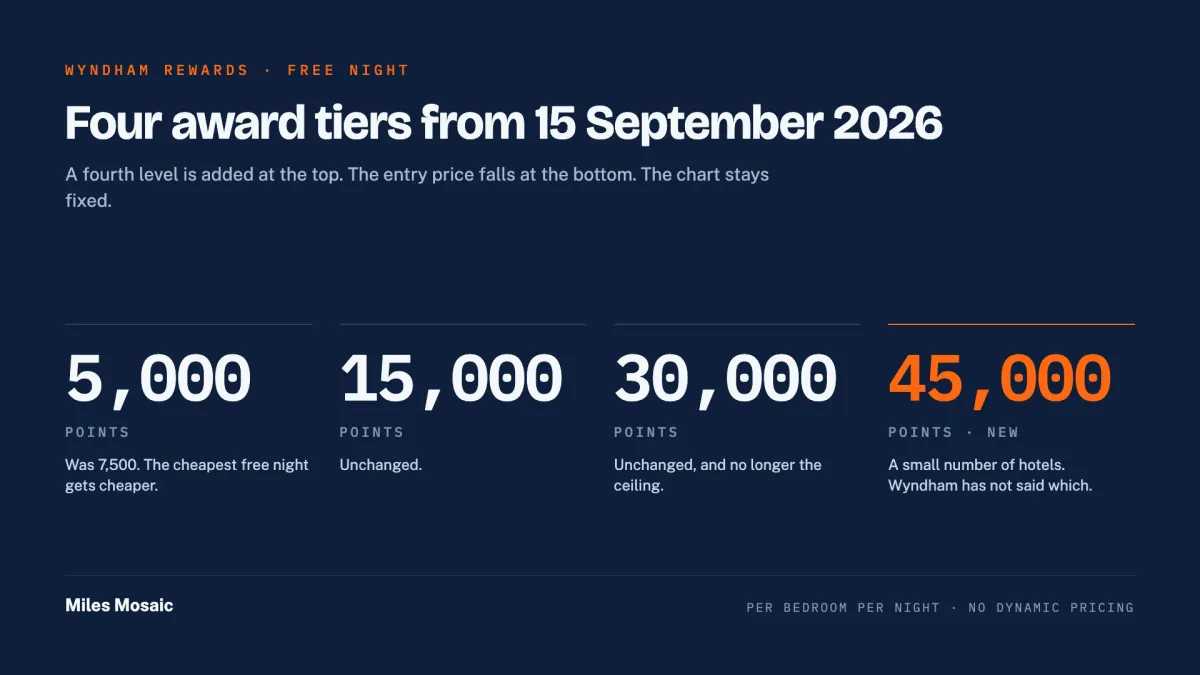
Settled. From 15 September 2026, Wyndham Rewards moves from three award tiers to four. The existing 7,500, 15,000 and 30,000 point levels become 5,000, 15,000, 30,000 and 45,000 points per bedroom per night, so the floor drops and a new ceiling appears. Bookings made with points before that date are honoured at the current rate, and Wyndham says a booking whose rate falls after the update will be refunded the difference automatically.
Not settled, as at 8 September 2026. Which hotels go where.
Wyndham’s reward tier updates page says hotels will be redistributed across all tiers, and that "while many will stay at their current tier, others will move, some lower, some higher", with the vast majority spanning the 5,000, 15,000 and 30,000 point levels. That last clause is a genuine reassurance and it is worth taking at face value. It is also not a list.
A member holding 30,000 points has no way to know whether the hotel they had in mind is about to cost 5,000 or 45,000, and therefore no way to decide whether to book now. With seven days to run, the only sensible response, which is to book anything you are reasonably sure about at today’s rate while today’s rate still exists, is a response the absence of information forces rather than one anybody chose. We set out the arithmetic either side of the change in our guide to the new 45,000-point tier.
Third-party sites have named a handful of properties expected in the top tier. Those attributions are not Wyndham’s and should not be treated as confirmed.
Settled. On 8 December 2026 Qantas launches Status Credit rollover and retires Points Club, Points Club Plus and Green Tier. The rollover caps are published: Silver members roll over 25 per cent of excess Status Credits to a maximum of 100; Gold, Platinum and Platinum One roll over 50 per cent, capped at 350 for Gold and 500 for Platinum and Platinum One.
Not settled, as at 8 September 2026. When the existing Loyalty Bonus ends.
Qantas’s programme changes page confirms that the Loyalty Bonus, currently paid for every 500 Status Credits earned on eligible Qantas or Jetstar flights up to four times a membership year, is being retired in 2027. It answers the obvious follow-up, which is what the last day to use one will be, with a promise rather than a date: "More details on the retirement of the Loyalty Bonus will be shared in 2027."
This is the mildest case on the list, and it is included because of where the answer lives rather than what it says. The relevant text sits inside a collapsed accordion that does not render until a browser opens it, which is why it takes deliberate effort to read at all. Information that exists but is not retrievable is, for practical purposes, closer to information that does not exist. Our breakdown of the 2026 and 2027 Qantas changes goes through the rollover mechanics in full, including the two occasions on which Qantas has quietly moved the Gold cap.
Settled. From 8 September 2026, award tickets on Air France and KLM-operated flights split into Light, Standard and Flex. Flying Blue published the inclusion tables in full on its own site in August, cabin by cabin, ahead of the start date. Partner awards are unaffected, tickets issued before 8 September keep their original conditions, and status-linked benefits continue to apply.
Credit where it is due: this is the most complete pre-publication of any change on this list. Anyone who claims Air France-KLM said nothing has not looked. The tables are specific enough to settle arguments, including the detail that Business Standard includes lounge access while Business Light does not, and that Light in Business is limited to the O and Z fare classes.
Not settled. What any of it costs.
Flying Blue published no mileage prices and no differentials on that page. The comparison figures now in circulation, including the widely quoted 25 to 30 per cent gap between Light and Standard, come from illustrative examples the airline supplied directly to journalists. Those are airline figures, which makes them better than guesswork, but they are examples rather than a chart and they were never posted where a member can check them. You can of course price a specific itinerary and see a real number. What you cannot do is see the shape of the change before you start searching.
So the member-facing position on the morning the change lands is this: you can find out exactly what each fare includes, and you cannot find out what any of them costs until you price a specific itinerary. That is the inverse of the usual devaluation, where the price is announced and the inclusions quietly shrink. We took the change apart in detail, including which of the widely repeated claims are actually unsupported, in our analysis of the Light, Standard and Flex split.
Settled. The promotion that ran to 31 August 2026, which gave 20 per cent bonus Tier Miles and reduced tier thresholds by 20 per cent, has ended. The standing thresholds are back: 25,000 Tier Miles for Silver, 50,000 for Gold, and 150,000 for Platinum together with at least one qualifying First or Business flight.
The problem. On 8 September, more than a week after it ended, Emirates’ programme-updates page still carried the promotion, with its reduced thresholds of 20,000, 40,000 and 120,000 Tier Miles and live "Book with Emirates now" calls to action. The copy does say "Until 31 August 2026" directly above those buttons, so this is not a page that misleads anyone who reads it carefully, and it should not be described as one. It is a stale page: an expired offer still given prominence, with its closed status left to be inferred from a date rather than stated.
There is a second and quieter problem with that page, and it is the one that matters more. It carries a robots meta tag reading NOINDEX, NOFOLLOW, read directly from the rendered document head on 8 September 2026. That instruction asks search engines not to index the page and not to follow its links, so the page where Emirates publishes its programme changes is the page a member is least likely to reach by searching for those changes. Emirates has not said why, and there are innocent reasons a marketing team might set it. The effect on a member looking for the current rules is the same either way.
That page is also the only source for something that genuinely matters. From 1 June 2027, Skywards Miles earned from that date will expire three years after the flight or partner activity, rounded to the end of the month, replacing the current birth-month rounding. Miles already in the account are unaffected. That is a real change to how a balance behaves, it is correct, and it is published somewhere search engines have been told to ignore.
Two counter-examples from the same fortnight are worth putting alongside the five above, because a piece like this can slide into implying the whole industry is at fault, and it is not.
KrisFlyer improved its transfer ratio to yuu Points on 1 September, from 1:1.325 to 1:1.5, with the minimum transfer down from 2,000 miles to 1,600, as reported by The MileLion and by Mainly Miles within a week. A small change, clearly stated, with an effective date attached.
And the Civil Aviation Authority of Singapore, introducing a new per-passenger levy on departures from Changi, published a full rate table by distance band and cabin, two separate effective dates, a deferral notice when the timetable moved and a confirmation notice when it settled. That is a government agency rather than a loyalty programme, and the comparison is not entirely fair. It is also not a clean sweep, because CAAS has left at least two operative questions unanswered, as our explainer on the SAF levy and award tickets sets out. But it demonstrates that the rates, bands and effective dates of a change affecting millions of tickets can be published in full, fourteen months ahead, on a page that stays where it was put.
Three explanations are plausible and none of them requires bad faith.
Regulatory approval is the obvious one for Asiana. The mileage-integration plan for the Korean Air merger has been before the Korea Fair Trade Commission for more than a year. An airline cannot publish a process it has not been permitted to adopt, and announcing the deadline without the process may genuinely be better than announcing neither.
Commercial negotiation covers Wyndham. Property-level pricing in a franchised hotel group involves franchisees, and a tier list is a set of individually consequential decisions, some of which may still be under discussion a week out.
Competitive sensitivity covers Flying Blue. An award chart is a price list, and a programme with dynamic pricing has a real commercial reason not to publish one. That reason does not disappear because it is inconvenient for members, but it does explain why the conditions were published and the prices were not.
What the three have in common is that the cost of the incompleteness falls on the member rather than the programme. In each case the member is the one who has to decide something, with a date but without the rules.
Seven things, none of them clever, all of them cheap.
Diarise the date, not the announcement. The date is the part that is reliable. Put it in the calendar the day you read about it, with the programme name and what expires.
Where a deadline and a mechanism are separated, act on the earlier date. If Asiana’s request process arrives in November, the flights already flown are the ones exposed. Keep every boarding pass and booking confirmation for any Star Alliance partner flight you take from 16 October onwards and want Asiana Club miles for, before knowing whether you will need them.
Save the terms as they read on the day you book. Existing bookings are often honoured under the rules in force when they were made, which holds for Wyndham, for Flying Blue and for Qantas’s rollover, but the honouring is easier to insist on when you can show what the rules said. A saved page or a PDF is enough. This matters most where the change is to what a ticket includes rather than what it costs, which is the pattern we traced in unbundling, the new devaluation.
Check what the deadline is actually keyed to. Asiana’s cut-offs key off the departure date, so booking early buys you nothing at all. That lesson applies to any qualification or earning deadline, where "book before" and "fly before" are entirely different instructions, and it is the single most common way a member does everything right and still misses.
When two of a programme’s own pages disagree, trust the one that governs. A tier page describing current thresholds beats a news page describing a promotion. A terms page beats a marketing page. If in doubt, the page that would be quoted back at you in a dispute is the one to plan against, which is the same test we apply to verifying a status match offer.
Treat "details to follow" as a diary entry, not an answer. Set a reminder for a fortnight before the deadline, or for tomorrow if the deadline is already closer than that, which for Wyndham’s 15 September it is. If nothing has been published by then, that is itself the answer, and you can act on the assumption that the process will be inconvenient.
Look at the page in a browser before concluding nothing was published. This one is new to this article and it cost us a section. Flying Blue’s announcement page returns an empty shell to anything that does not run JavaScript, so a check that would find a Wyndham or Qantas page finds nothing there. If a programme appears to have said nothing, open the page properly before believing it.
The underlying difficulty is not any single one of these. It is holding five of them at once, across five programmes, each with its own qualification year and booking window and expiry clock, when the announcements arrive at random and the details arrive later or not at all. That is the tedious, unglamorous part of frequent travel, and it is what Miles Mosaic exists to take off your hands: booked flights, stays and status deadlines across 31 programmes, 24 airline and seven hotel, visible together, so a date buried in a June member notice is not something you have to remember unaided in November. The free Explorer tier is ad-supported; Pro, at $14.99 a month, removes the ads. If you are working out which deadlines apply to you at all, our elite status qualification calendar is the place to start.
If another two or three programmes set a member-facing deadline this year without publishing how to meet it, this stops being a run of coincidences and becomes the normal way changes get communicated: a shape announced early, a detail supplied late, and the interval in between carried by the member.
The specific dates to watch are Wyndham’s property list before 15 September, Asiana’s request process before 16 October, whether Flying Blue ever posts award pricing rather than briefing it, and whether Emirates either corrects its programme-updates page or lets search engines see it. If all four arrive in time, this article ages into a note about a bad fortnight, which would be the better outcome.
See your requalification forecast in under a minute. No account, and never a loyalty password.
Forecast my status, free →Share
Last reviewed: · How we research and update
Six loyalty changes kept a headline price or benefit name and cut what it contained. Why the usual devaluation tests miss most of them.
Read article →Asiana exits Star Alliance on 16 December 2026, but earning on Asiana flights stops on 15 October. Every deadline, by partner airline and b…
Read article →Wyndham moves to four award tiers on 15 September 2026, adding 45,000 points and dropping the floor to 5,000. What changes, and the rate lo…
Read article →Status Credit rollover, earning Status Credits on the ground, a single target per tier and the end of Points Club. What Qantas is changing …
Read article →