Korea’s Fair Trade Commission approved the Korean Air and Asiana mileage integration plan in September 2026. Asiana miles earned by flying convert to Korean Air SKYPASS miles at one to one, miles earned through partners convert at one to 0.82, and the integrated programme takes effect on 17 December 2026.
One small precision first, because several English summaries blur the two dates. The Commission’s own release states that it approved the plan on 14 September 2026. The release was posted on 15 September, which is also the date Korean Air said it had received approval and the date Asiana’s member notice carries. Yonhap got the distinction right on the day; a lot of the secondary coverage did not. The member deadlines below run from the notices rather than from the decision.
It took four years from the conditional clearance of the airline merger itself, and several rejected drafts, to get there. The terms quoted in every English-language write-up since early 2025 are, as of this month, the terms.
If you read the earlier version of this article, you were told to watch for one thing and one thing only: Korean Air said its mileage-integration site would open after approval, and that when the site appeared the details were real. The site is open. That is the cleanest confirmation available, and it arrived alongside a member notice from Asiana saying the plan has been finalised following the Commission’s approval.
So the useful thing an article can do now is not to repeat the ratios one more time. It is to set out what the approved plan actually asks you to do, and by when, because the answer is four separate decisions clustered in the next ninety days. They arrived in three different notices, they have three different deadlines, and the first of them falls on 1 November and can cancel a booked flight.
What is now settled
The approval. The Commission approved the mileage integration plan on 14 September 2026 and published the decision the following day. Asiana’s own member notice of 15 September confirms it and puts the integrated programme into effect on 17 December 2026, the day the two airlines combine.
The ratios. Miles earned by flying convert at one to one. Miles earned through credit cards and other partners convert at one to 0.82: 820 SKYPASS miles for every 1,000 Asiana miles. Korea JoongAng Daily’s report of the decision sets out both, and notes that Korean Air must comply with the terms for a full decade after the merger.
The ten-year ring-fence. Asiana balances move to Korean Air but are held and managed as a separate currency for ten years. You may convert at any point in that decade, and anything still unconverted at the ten-year mark converts automatically at the same ratios.
Conversion is all or nothing. You cannot move flight-earned miles at one to one and leave partner-earned miles behind at 0.82. The whole balance goes or none of it does, which means the two published ratios function as a single blended rate determined by how you happened to earn.
Your expiry dates are untouched. This was true before approval and remains true. Miles earned since October 2008 carry ten-year validity from the date of earning, and neither the merger nor the ring-fence extends, pauses or resets that. The ten-year separate-operation period is the life of the currency, not a lease of life for your balance. Those two periods roughly coincide, which is why they are conflated in almost every summary going round.
The part nobody is printing: what the two currencies can buy
Here is the finding that changes the decision, and it is not a ratio.
Korean Air’s integration site sets out, side by side, what each currency redeems for during the separate-operation period. They are not the same list.
Read that second-to-last row slowly. Former Asiana Mileage does not book partner airline awards. Korea JoongAng Daily’s account of the approved plan is consistent: it describes non-converters as able to use their miles across all routes operated by the merged Korean Air, which is Korean Air metal and nothing else.
This matters because it inverts the advice that follows naturally from the ratio alone. If all you know is that partner-earned miles take an 18 per cent haircut, the obvious move is to hold your Asiana miles and spend them as Asiana miles. But the miles you hold cannot reach the SkyTeam network. A member sitting on a balance intended for a partner redemption, whether Delta, Air France, KLM, Vietnam Airlines or Garuda, has to convert to reach it, and pay the blended rate to do so.
The real question is not what conversion costs you. It is what you want to buy, and whether the currency you are holding can buy it. Those give different answers for different members, and only one of them has been reported.
The elite ladder, now final
Asiana’s tiers map onto Korean Air’s, and Korean Air has created a tier to make the mapping work. The table below is read off Korean Air’s own integration site.
Morning Calm Select Club did not exist before this plan. Korean Air is adding a tier specifically to absorb Asiana’s Diamond population, and it carries SkyTeam Elite Plus benefits. That is a meaningful detail for a Diamond holder: Elite Plus is the SkyTeam equivalent of the Star Alliance Gold recognition being lost, so the lounge access and priority services survive the alliance change under a different badge.
After the separate stage, tiers are reassessed on combined performance, with Korean Air qualification miles and Asiana-operated flight miles added together. If you hold status in both programmes today, that combination works to your advantage rather than against it.
One condition the Commission attached is worth knowing and is not in the English coverage. A limited-term elite member on the 24-month clock who had already met the retention conditions before 17 December 2026 keeps that tier for a further 24 months beyond the original end date. If you qualified this year and expected the merger to reset you, it does not.
Four decisions, and they are not the same decision
This is the section missing from the coverage, and it is the one with a member action attached.
Asiana has published four separate things a member can be asked to decide. They arrived in three different notices, they have three different deadlines, they use different channels, and the consequences of getting them wrong range from nothing at all to a cancelled flight. They are routinely reported as one thing. They are not one thing.
The first row is the one to act on, and it is the one nobody is reporting. It is not about miles at all. Asiana’s notice of 14 September 2026 on flight-number changes says your ticket booking information and the personal data inside it, including name, contact number, email, passport number, card number, date of birth, gender, membership number and booking reference, transfer to Korean Air. Members who do not consent must notify Asiana or their ticketing agency by 10pm Korea Standard Time on 1 November 2026. The consequence of refusing is not a lost benefit. It is that the booking is cancelled and refunded. If you hold an Asiana ticket for travel around the merger, doing nothing is what keeps the flight.
The second and third rows are about the Asiana Club account rather than a ticket, and both end it. If you terminate your membership over the terms change, your membership is cancelled and remaining Asiana Club miles expire under the existing terms. If you refuse the member-record transfer, your membership is cancelled, remaining mileage can be used before cancellation, and it expires on account closure. Neither is a way of keeping your miles and declining the merger. They are both ways of ending the account, and anyone considering either should spend the balance first.
The fourth is a different animal: a consent to give rather than an objection to lodge, with no published deadline but a stated consequence from 17 December. Asiana notes that members already registered with Korean Air SKYPASS do not need to consent separately.
One squeeze worth planning around. The English mileage notice tells members who object to the member-record transfer to notify their regional Asiana Airlines Reservation Center by 16 December 2026, and Asiana’s notice of 16 September gives that centre’s service end date as 16 December 2026. A member who acts on the last permitted day is calling a line on the last day it answers. Read the closure notice carefully, too, because it does not agree with itself: its detail fields say 16 December while its opening prose says 17 December. Take the earlier of the two. The Korean-language mileage notice names the Asiana Club Service Center rather than the regional reservation centre, so use whichever channel your own notice names, and do not leave it to December.
There is also a further notice dated 21 September 2026, covering personal information collected through service use and business relationships more broadly. It offers a web route, through the Customer Service page on Asiana’s website, and publishes no deadline of its own. It does not move any of the dates above.
The claim procedure, published on 30 September
One thing the approval did not cover was how Asiana Club members earn on Star Alliance partner flights in the last weeks before the exit.
Asiana’s notice of 23 June 2026 said that for partner flights between 16 October and 16 December 2026, accrual would be available only through a separate request made after the flight, and that the request process would be announced later. When this piece was revised on 22 September, that process had been promised for 91 days and was still unpublished.
It arrived on 30 September. Claims go through the Earn Missing Miles page of flyasiana.com between 09:00 KST on 2 November and 17:00 KST on 16 December 2026, with both the boarding pass and the e-ticket receipt, and take three to five business days to post. The same notice moved the Copa, ANA and LOT award deadlines. Our guide to the Star Alliance claim process and award deadlines sets out every date by action and by airline.
The gap between the date and the procedure was small next to a four-trillion-won balance-sheet question, but it was the one most likely to cost an individual member miles they earned. It also fits a pattern we wrote about on 8 September in loyalty deadlines without rules: programmes are increasingly publishing the date before they publish the procedure, which transfers the planning burden onto the member without giving them anything to plan with.
A correction worth making explicitly
The 22:00 Korea Standard Time deadline on 1 November 2026 has been circulating for weeks, usually attached to the wrong thing. We checked it in both languages, and the useful answer is that the date is real and the attribution is wrong.
It is not a mileage consent deadline. It appears in the 14 September notice on flight-number changes and reservation data, in both English and Korean, and it governs the transfer of booking and ticket information. The mileage notice of 15 September publishes a different date, 16 December 2026, for the Asiana Club member record, and the third-party SkyTeam consent has no published deadline at all.
The practical consequence of the mix-up runs the wrong way. A member who treats 1 November as a mileage deadline will worry about the wrong thing and may miss it entirely, because the date that actually falls on 1 November can cancel a booked flight rather than restrict a balance. Check whether you hold an Asiana ticket first. That is the deadline in front of you.
What a Singapore or Southeast Asia member should notice
Two things, and the approval sharpens both.
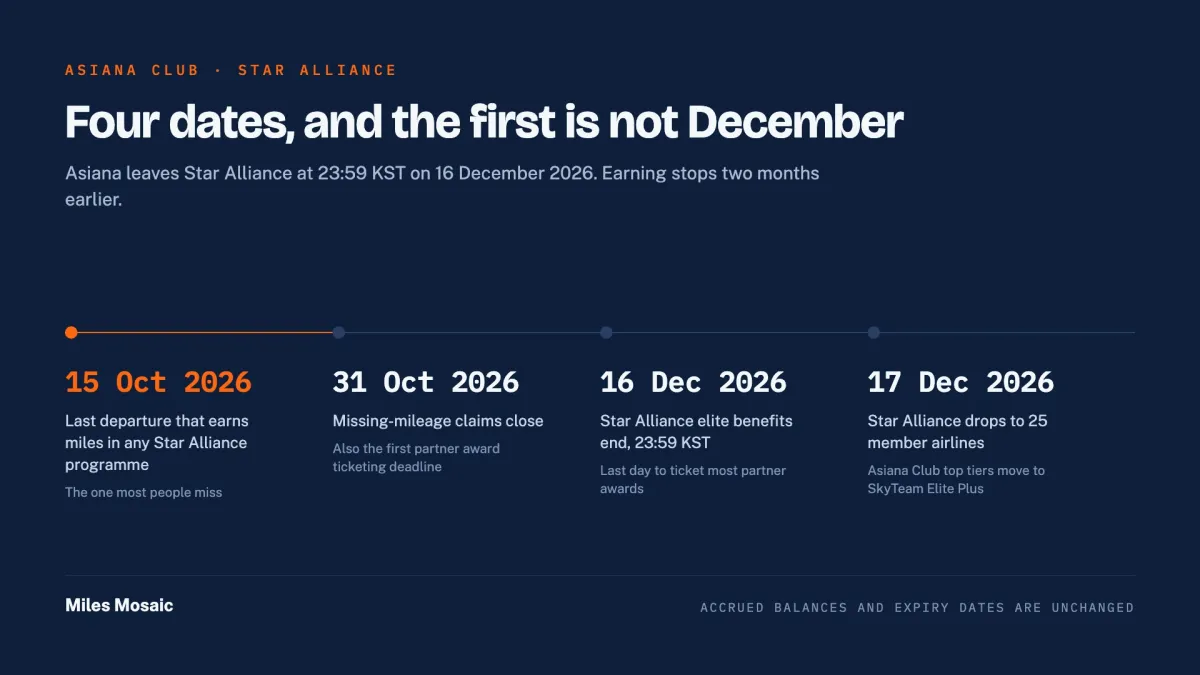
The first is that the Star Alliance earning route through Asiana closes on 15 October, and the fallback that remains is a currency that cannot book partner awards. A Singapore-based collector who has been crediting Asiana flights to KrisFlyer loses that option in three weeks. Crediting to Asiana Club instead now means holding a balance that, from December, buys Korean Air metal and Korean Air metal only until you convert it. Our comparison of KrisFlyer against Asia Miles and Avios is the place to start if you are picking a new home programme, and the qualification calendar will show how much of the year is left to make up a shortfall.
The second is about award availability, and it cuts against the instinct to wait. The approval attaches real obligations to Korean Air: bonus seat availability on long-haul high-demand routes to the Americas, Europe and Oceania must be held at or above the combined peak levels the two carriers offered over the past decade, with annual reporting to a compliance monitoring committee. A Korean Air spokesperson told Korea JoongAng Daily that the airline plans to run redemption volume around 20 per cent above the combined pre-merger total. If that holds, seats should be easier to find, not harder. But a large deferred balance that starts moving at once produces exactly the squeeze the guarantees are meant to prevent, and the members best placed are still the ones who redeem before the crowd rather than after it. The reasoning behind that is set out in our guide to surviving a devaluation.
What to do now
Work out what you are actually saving the miles for. This is the decision the redemption-scope table forces, and it comes before the ratio. If the answer is a Korean Air flight, you can hold and spend without converting. If the answer involves any SkyTeam partner, conversion is not optional and the only question is when.
Find your own expiry date this week. The merger does not touch it and no published timeline shows it. It is the one date in this story that is specific to you, and it has taken more balances quietly than any devaluation. Our reference on which points and miles actually expire covers the four mechanisms, and the free points expiry tool holds the per-programme rules.
Do not open an account-closing door by accident. Terminating membership over the terms change and refusing the data transfer are both offered as member rights, and both end with your miles expiring. If either appeals to you, spend the balance first and close the account afterwards.
Give the consent, or accept the restriction knowingly. The SkyTeam sharing consent is the one with no deadline and the clearest consequence: without it, earning, redeeming and elite benefits are restricted from 17 December. If you already hold a SKYPASS account, Asiana says you do not need to act.
If you have an Asiana flight you want credited to a Star Alliance programme, move it to a departure on or before 15 October. The rule keys off the departure date, not the booking date. A November flight has no Star Alliance option however early it was bought. The deadlines by partner airline are in our companion piece on the Asiana Star Alliance exit.
Sort your balance by how it was earned, even though you cannot split it. You cannot hedge, but the proportion that came from cards, hotels and retail is what sets your blended rate. The higher it is, the worse conversion looks and the stronger the case for spending as Asiana miles, provided what you want to buy is on the shorter list. If you have been pooling across household accounts, do that arithmetic before converting rather than after.
Holding two balances with different redemption rights, two status positions, an alliance change and four dated decisions across two airline logins is the part people get wrong, and a status ladder you are part-way up is easy to abandon by accident when the programme underneath it changes shape. Seeing programmes side by side with their deadlines attached is why Miles Mosaic exists. It tracks miles, points and elite status across 31 programmes, 24 airline and seven hotel, plus eight transferable card currencies, and it never asks for an account password. Explorer is free and ad-supported; Pro is $14.99 a month and ad-free. If a soft landing is what you are expecting from the tier match, it is worth knowing where you stand before December rather than after.
Sources & references
Every date, ratio and consequence above was read at source on 17 and 22 September 2026. External sites open in a new tab.
- Asiana Airlines, Notice on Mileage Integration Plan for Korean Air and Asiana Airlines, 15 September 2026 (accessed 22 September 2026)
- Asiana Airlines, Notice on flight number changes and transfer of reservation and ticket information, 14 September 2026, for the 1 November 22:00 KST deadline (accessed 22 September 2026)
- Korean Air, mileage integration information site (accessed 22 September 2026)
- Asiana Airlines, Reservation Center closure and integration with Korean Air contact numbers, 16 September 2026 (accessed 22 September 2026)
- Asiana Airlines, Notice of end of Star Alliance mileage partnership and elite benefits, 23 June 2026 (accessed 22 September 2026)
- Korea JoongAng Daily, Korean Air and Asiana merger mileage plan approved with 1:1 conversion and 10-year validity, 15 September 2026 (accessed 22 September 2026)
- Korea Fair Trade Commission, press release on final approval of the Korean Air and Asiana mileage integration plan, decision dated 14 September 2026 and published 15 September 2026 (accessed 22 September 2026)
- Yonhap News Agency, report of the approval, 15 September 2026 (accessed 22 September 2026)