KrisFlyer vs Asia Miles vs Avios in 2026
A 2026 comparison of KrisFlyer, Asia Miles, and Avios: expiry rules, redemption strengths, transfer access, and which programme fits which …
Read article →Independent Miles Mosaic guide. No programme partnerships, no account linking, no scraped balances. Sources cited below; corrections welcomed.
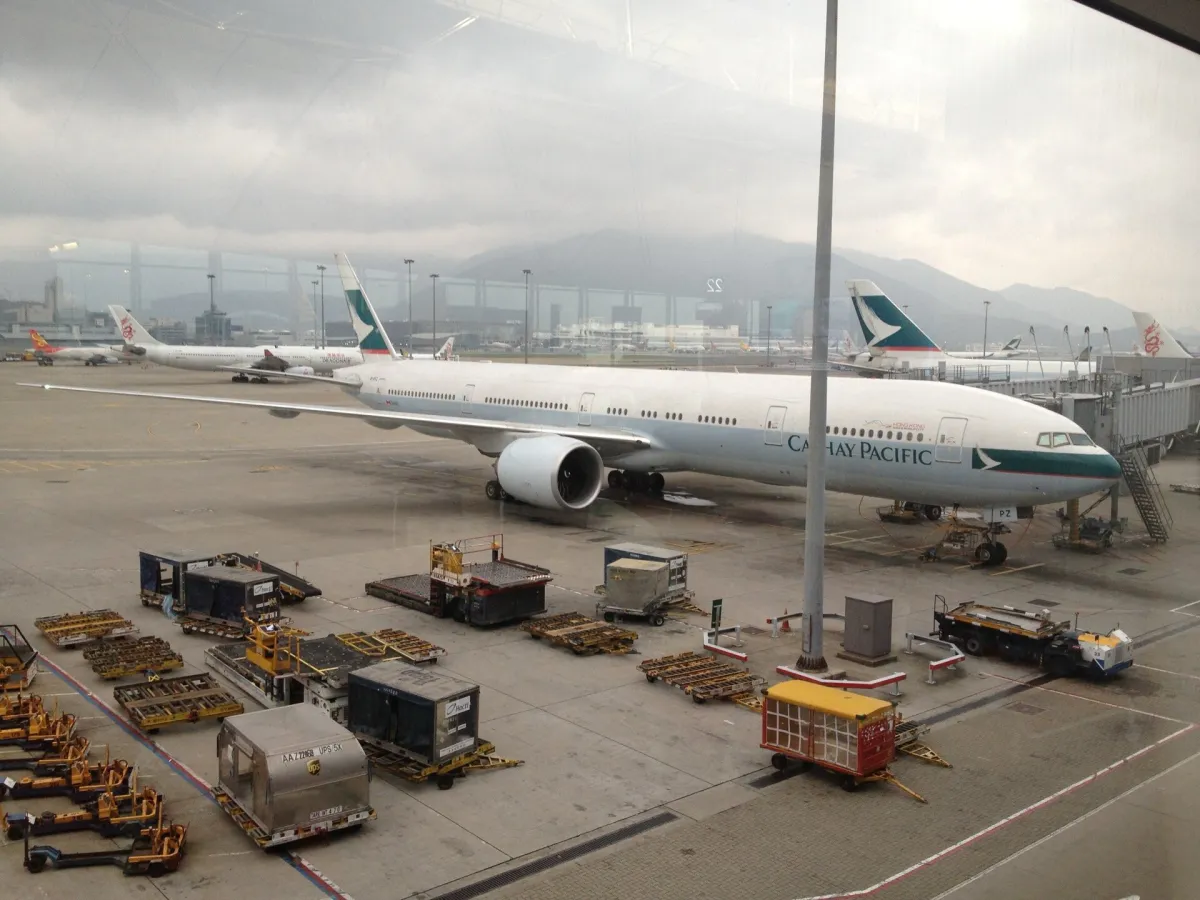
Cathay Pacific has raised its carrier-imposed fuel surcharges by up to 41 per cent for tickets issued from 1 August 2026. On a long-haul sector out of Hong Kong the charge moves from HK$965 to HK$1,362, roughly US$123.70 to US$174.60. What matters most is that the rate is fixed by your booking date, not your travel date.
Updated 1 August 2026: the new rates are now in effect. The figures and the booking-date mechanics below are unchanged, and the comparison of which programmes charge nothing at all is the part that still matters if you are planning redemptions.
Cathay publishes its surcharges per sector in Hong Kong dollars, banded by region, and files them separately by point of origin. The table below is the Hong Kong panel from the airline's own fuel surcharge notice, which the airline reviews and revises roughly every two weeks. The rest-of-world panel currently carries the same figures, and the worked examples below assume that parity holds; if you are pricing a journey that starts outside Hong Kong, check your own origin's panel rather than assuming.
| Band | Until 31 July 2026 | From 1 August 2026 | Change |
|---|---|---|---|
| Hong Kong to Chinese Mainland | HK$165 | HK$198 | +20% |
| All other flights, including Singapore and North Asia | HK$241 (about US$30.90) | HK$339 (about US$43.50) | +41% |
| South Asian Sub-Continent | HK$448 (about US$57.43) | HK$633 (about US$81.20) | +41% |
| South West Pacific, North America, Europe, Middle East, Africa | HK$965 (about US$123.70) | HK$1,362 (about US$174.60) | +41% |
The 41 per cent headline is accurate for three of the four bands but not for all of them. Mainland China sits in its own cheaper band and rose by 20 per cent, so anyone quoting a flat 41 per cent across the network is overstating it for short cross-border hops.
It is also worth being precise about what this reverses. Cathay cut surcharges three times as oil prices eased earlier in 2026, on 16 May, 1 July and by about 17 per cent on 16 July, taking the long-haul band from HK$1,362 down through HK$1,164 to HK$965. The August increase undoes the last two of those cuts and lands exactly back on the level that applied between 16 May and 30 June. Cathay's own notice points out that the new rate is still below April's peak, which is true and worth keeping in view before this reads as a devaluation story.
Surcharges are charged per flight segment, not per ticket, so a return trip counts twice and a connection adds more. Two worked examples using the figures above.
A round trip between Singapore and Hong Kong is two sectors. Under the old rate that is about US$61.80 in carrier-imposed charges. Booked from 1 August, it becomes about US$87.00.
A round trip between Singapore and San Francisco via Hong Kong is four sectors: two short-haul and two long-haul. Under the old rates that is roughly US$309.20. From 1 August it is about US$436.20, an increase of around US$127 on a single itinerary.
None of that includes airport taxes and government fees, which are separate and are added on top. A departure from Singapore Changi currently adds S$65.20, made up of a S$46.40 Passenger Service and Security Fee, a S$8.00 Aviation Levy and a S$10.80 Airport Development Levy, per Changi Airport Group's published schedule of fees. Those figures hold until 31 March 2027, after which the departing total rises to S$70.20. A separate sustainable aviation fuel levy begins on 1 January 2027, applying to tickets sold from 1 October 2026.
The label is misleading and always has been. What airlines levy is a carrier-imposed charge, usually filed under the tax code YQ, and it is not a tax in any meaningful sense. It is revenue kept by the airline, filed separately from the base fare, and it is not remitted to any government or airport authority. Regulators have pushed back on the terminology for exactly that reason. In the United States the Department of Transportation's full-fare advertising rule requires carrier-imposed charges to sit inside the advertised total rather than be presented as a government-style tax, which is a large part of why most carriers now describe them as carrier-imposed surcharges in their own fare rules.
Two features of that design explain why it matters so much to award travellers. The first is that a surcharge sits outside the award chart. An airline can raise the cash cost of every redemption in its programme without touching a single mileage figure, and without the announcement cycle a genuine devaluation would attract. The second is that it is filed per sector and per direction, so it scales with itinerary complexity rather than distance. A four-sector routing pays four times, even if two of those sectors are short positioning hops.
That combination is why two programmes can price the same physical seat hundreds of dollars apart. The miles look comparable; the cash does not. It is also why the useful question is never which programme has the cheapest award chart, but which programme gets you into that seat for the lowest total of miles and cash together.
The surcharge attaches when the ticket is issued. That means a booking made on or after 1 August 2026 carries the higher charge even for travel much later in the year, and a booking made on 31 July keeps the old rate for travel well into 2027. Cathay's own notice states only that the change is effective 1 August; the booking-date mechanic is confirmed by the specialist outlets that cover the airline closely, with The MileLion noting on 24 July that the booking date is what matters rather than the travel date.
Two consequences follow. Tickets already issued are unaffected, so there is no retrospective charge. But a voluntary change that requires the ticket to be reissued can trigger repricing at the current rate, which turns a routine date move into a real cost on a long-haul itinerary. If you hold a Cathay ticket issued before August and are considering a change, price the reissue before you commit to it.
For award travellers this is where the increase hurts most, because Cathay passes carrier-imposed surcharges through to Asia Miles redemptions in full. A long-haul redemption in either direction is now carrying about US$174.60 per sector in cash on top of the miles, which on a Hong Kong to London return is roughly US$349 before airport taxes.
That does not make Asia Miles a bad currency. It does change the comparison against programmes that charge nothing, and the gap is now wide enough to change which miles you should be spending on a given trip. The table below sets out where the major programmes stand.
| Programme | Carrier-imposed surcharge on awards |
|---|---|
| Air Canada Aeroplan | None across 45-plus partners. A partner booking fee of CA$39, roughly US$29, still applies |
| United MileagePlus | None |
| Singapore Airlines KrisFlyer | None on Singapore Airlines-operated flights. Partner awards can carry the partner's surcharge |
| Alaska Mileage Plan | None on most partners, with real exceptions including British Airways |
| Virgin Atlantic Flying Club | Charged on many partner awards, waived on some short-haul and domestic segments |
| British Airways Club (Avios) | Charged, high on British Airways metal. None on American, Alaska, JAL or domestic Qantas |
| Cathay Asia Miles | Charged in full, at the rates above |
Two entries in that table are commonly reported wrongly and are worth stating carefully. Virgin Atlantic is often listed as surcharge-free; it is not, and it has added substantial charges on partner awards including Delta One. Alaska is close to surcharge-free but not absolutely, so check the specific partner before assuming.
Singapore Airlines is the clean comparison for anyone flying the same routes. It removed fuel and insurance surcharges from redemption tickets on its own flights for bookings ticketed on or after 23 March 2017, and that position has held since. One nuance is regularly garbled elsewhere: on cash fares Singapore Airlines did not abolish the surcharge, it folded it into the base fare from 28 March 2017. The removal applies to award tickets, and only on Singapore Airlines-operated flights. Our comparison of KrisFlyer, Asia Miles and Avios works through what that difference means over a year of redemptions.
Existing tickets are safe, but the safety is narrower than it sounds and the distinction is worth understanding before you touch a booking.
The surcharge attaches at ticketing, so a ticket issued before 1 August 2026 carries the old rate for the life of that ticket. What breaks the protection is reissue. A voluntary change that requires the ticket to be reissued generally reprices the whole itinerary at current rates, which on a four-sector Europe trip means picking up roughly US$127 in additional surcharges on top of any change fee or fare difference. Involuntary changes made by the airline do not have that effect.
The practical consequence is that a routine date move on a long-haul Cathay booking is now a materially more expensive decision than it was in July, and the cost is invisible until you see the reissue quote. If you are weighing a change on a ticket issued before August, ask for the total reissue cost including taxes and surcharges rather than just the change fee.
Award tickets follow the same logic. An Asia Miles redemption issued in July carries July's surcharge; cancelling and rebooking it, even for the same flights, does not.
The honest answer is that there is not much to do beyond adjusting which currency you reach for. Three things are worth acting on.
Reprice the comparison, not just the miles. A redemption that looked good at US$123.70 a sector may not at US$174.60. The number to compare is always miles plus cash against the cash fare, and this increase moves the cash side by enough to flip some marginal cases. Our value of a mile tool is a quick way to sanity-check a redemption before you commit to it.
Route around it where the network allows. Because the charge is per sector, an itinerary with fewer Cathay segments carries less of it. A one-stop routing on a surcharge-free programme can beat a Cathay redemption outright once the cash is counted, even if it costs more miles.
Do not panic-book. Surcharges have moved four times in 2026 alone, three of them downwards, and Cathay has demonstrated it will cut them when fuel allows. Booking a trip you were not going to take in order to beat a deadline is how people end up with change fees larger than the saving. Our guide to surviving devaluations covers the general version of that mistake.
The wider point is that fuel surcharges are the least visible part of a redemption and the most volatile. They sit outside the award chart, change without a formal devaluation announcement, and are the reason two identical-looking redemptions on different programmes can differ by hundreds of dollars. Keeping track of which of your balances sit in surcharge-free programmes, and which do not, is a genuinely useful piece of bookkeeping. Miles Mosaic tracks balances and status across programmes so that comparison is in front of you when you are deciding where to spend, without ever asking for an account password.
See your requalification forecast in under a minute. No account, and never a loyalty password.
Forecast my status, free →Share
Last reviewed: · How we research and update
A 2026 comparison of KrisFlyer, Asia Miles, and Avios: expiry rules, redemption strengths, transfer access, and which programme fits which …
Read article →Cathay's programme changes on 1 January 2027: Status Points stop resetting, membership moves to calendar years, rollover arrives and Diamon…
Read article →A 2026 guide to ultra-long-haul award strategy: the programmes, route types, and booking frameworks that still create genuine premium-cabin…
Read article →A 2026 guide to handling loyalty devaluations, partnership changes, and transfer-ratio shocks without letting your points strategy collapse…
Read article →