Lufthansa will sell you Frequent Traveller status for €650. American Express will give you ALL Accor Gold for holding a card you may already hold. IHG will sell you Platinum Elite, wrapped inside Ambassador, for US$225 a year. None of these requires a single additional flight or night, and all three were live as of 3 August 2026.
The catch is not that the offers are fake. They are real, and the terms are on the programmes' own websites. The catch is what you receive. In almost every case you are given the tier and not the qualifying nights or points that normally sit behind it, which means the benefit lands this year and contributes nothing towards next. That distinction is the whole decision, and it is missing from most coverage of these offers.
Three mechanics, often confused
Bought status is a straightforward transaction: money or miles for a tier, with no travel requirement. Lufthansa's current offer and IHG Ambassador are the clearest examples.
Matched status takes a tier you already hold somewhere else and mirrors it. Bilt's 1 August Accor promotion worked this way, as does the reciprocal arrangement between Marriott Bonvoy and Japan Airlines. If matching is the route you are weighing, the wider status-match landscape covers the standing offers this article does not.
Granted status arrives as a benefit of something else you hold, usually a premium credit card. American Express Platinum is the dominant example, and its hotel-status bundle grew again in July. The mechanics of that route, card by card, are set out in our guide to credit-card shortcuts to elite status.
The three feel similar to the recipient. They differ in one respect that matters more than price.
The five routes
Read the last column and two rows stand apart. Hyatt is the only route that asks you to travel and rewards you for it with genuine qualifying nights. The Bonvoy-to-JAL direction is the other qualified case, and for a different reason: FLY ON Points are the currency JAL qualification runs on, so a grant denominated in them is at least the right unit, a point developed below. The rest hand you a tier and leave your qualification where it was.
Lufthansa: the one with a deadline
Miles & More opened a paid Frequent Traveller offer on 29 July 2026 and it runs to 30 September 2026. The price is €650 or 80,000 miles, VAT included, with miles debited automatically on completion. The status runs to 28 February 2027.
Two conditions do most of the work and are routinely left out of secondary coverage.
First, you must currently hold no frequent flyer status: no Frequent Traveller, no Senator, no HON Circle. This is not an upgrade path for someone who slipped a tier. Miles & More runs a separate renewal offer for members who lost Frequent Traveller in March 2026; the two are different products.
Second, you must hold a specific qualifying co-branded credit card from a named list, and the list is narrower than "a Miles & More card". It is Deutsche Bank Gold cards in Germany, Advanzia and UniCredit in Italy, Swisscard and Cornèr Bank in Switzerland, Erste Bank and Sparkasse in Austria, and in Belgium the Beobank Brussels Airlines Altitude or Navigator Mastercard, which is Brussels Airlines-branded rather than Miles & More-branded. Five countries in total: Germany, Italy, Switzerland, Austria and Belgium. If you are outside them, this offer is not available to you at any price.
It is one-time use, cannot be bought for someone else, is payable only by card or Apple Pay in euros, and is refundable within 14 days if unused, though not if you subsequently earn the status by flying. Status shows in the account in about a week.
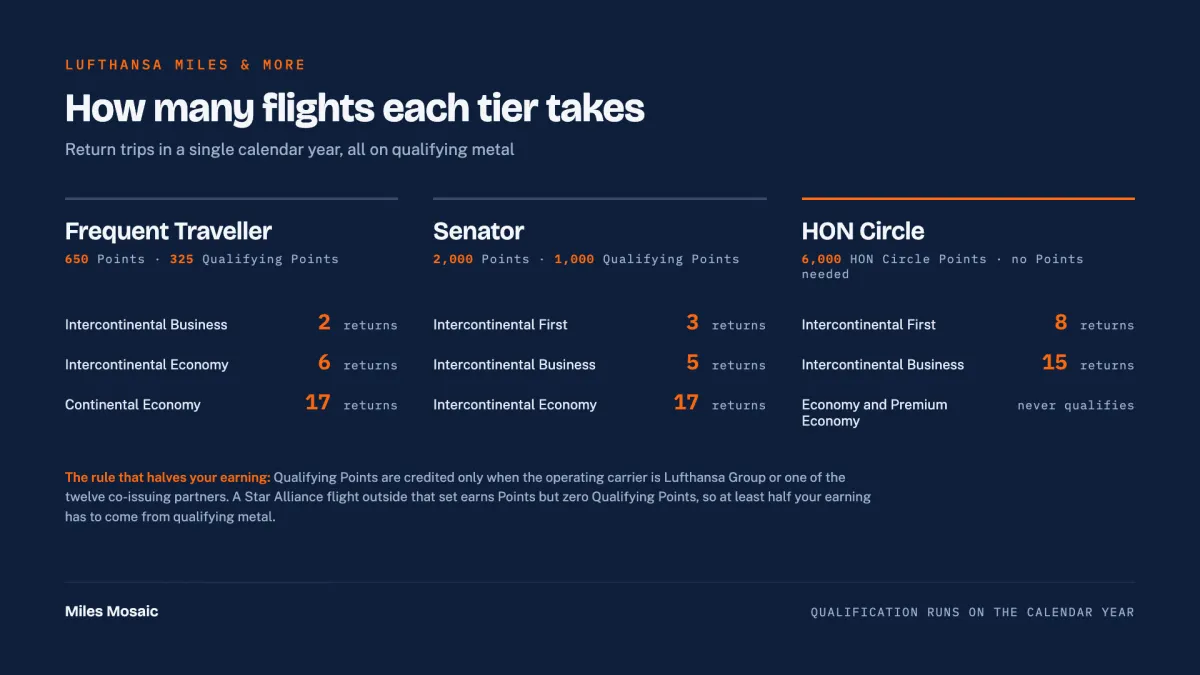
Whether €650 is fair depends entirely on what Frequent Traveller would otherwise cost you in flying. The guide to how many flights Miles & More status actually takes sets out the Points table and the Qualifying Points rule that halves usable earning on many fares. Read that first, then decide. For a lot of people the honest answer is that the flying was never going to happen, and €650 buys seven months of lounge access and priority handling. For anyone within realistic reach of the threshold, buying it wastes the progress they were about to make.
Amex Platinum and ALL Accor: the Singapore question
Accor announced a partnership with American Express on 22 July 2026 covering 12 markets: Australia, Austria, Canada, France, Germany, Hong Kong, Italy, Japan, Mexico, Singapore, the United Kingdom and New Zealand. Some coverage has added the United States to that list. Accor's own release does not include it.
Consumer, Small Business and Corporate Platinum Card Members are eligible for ALL Accor Gold: free Wi-Fi, welcome amenities, late check-out, room upgrades subject to availability and bonus points, with Amex's UK page specifying a 48% bonus on Reward points for eligible stays. Amex's page ties the benefit to remaining an eligible Cardmember and sets no fixed end date.
For a Singapore-based reader there is a gap worth knowing about. Singapore is a named launch market in Accor's release, but as of 3 August 2026 the benefit is not listed on American Express Singapore's Platinum travel-benefits page, which still shows Radisson Rewards Premium, Pan Pacific DISCOVERY Platinum, Marriott Bonvoy Gold Elite and Hilton Honors Gold, and is footered as accurate to 1 January 2026. Accor's release says the partnership launches in phases across 2026, so the likeliest reading is that Singapore is announced but not yet live. If you hold a Singapore Platinum card, this is one to check again in a few weeks rather than to plan a stay around today.
The compounding point applies here with force. Neither Accor's release nor Amex's benefit page says anything about Status Nights or Status Points accompanying the granted tier. Both describe on-property recognition and earning, not qualification. Until one of them says otherwise, the safe reading is that the card gives you Gold benefits and no movement towards Platinum. That matters because Accor Platinum sits at 14,000 Status Points or 60 nights, against Gold at 7,000 points or 30 nights: the gap the grant does not close is the larger half of the ladder.
IHG Ambassador: the one you can straightforwardly buy
IHG Ambassador costs US$225 a year or 45,000 IHG One Rewards points, and it remains the most direct purchase of a hotel tier on the market. It includes IHG One Rewards Platinum Elite status, a guaranteed one-category upgrade, guaranteed 4pm checkout, a food-and-beverage credit of up to US$20 per stay, dedicated check-in, and one complimentary weekend night a year.
The weekend night is where the value case is usually won or lost, and its conditions are specific: valid 12 months, usable only on the second night of a minimum two-night paid weekend stay at InterContinental properties, and excluding InterContinental Alliance Resorts. If you have two InterContinental weekends in the year, the certificate alone can cover the fee. If you have none, you are paying US$225 for Platinum Elite and a series of upgrades.
Royal Ambassador, the tier above, remains invitation-only and cannot be bought.
Marriott and Japan Airlines: what a modern match looks like
Japan Airlines announced a loyalty partnership with Marriott Bonvoy on 14 July 2026, and the reciprocal status offering is the interesting part because it shows how these arrangements have evolved.
Linking accounts grants Bonvoy members annual JAL FLY ON Points with no flying required. Marriott's partner terms set the grant at 2,000 FLY ON Points a programme year for a base member, rising through 5,000 at Silver Elite, 10,000 at Gold Elite and 20,000 at Platinum Elite to 30,000 at Titanium Elite and 40,000 at Ambassador Elite.
Those are not trivial numbers in JAL's own terms. JMB Crystal begins at 30,000 FLY ON Points and Sapphire at 50,000, so a Titanium Elite member is handed a grant the size of the entry tier's entire threshold. What Marriott's terms do not say is whether partnership-granted FLY ON Points count towards JMB tier qualification or are excluded from it, and Japan Airlines has not published an answer either. That single unstated rule decides whether this is the one genuine exception on the list or another benefits-only grant wearing a qualifying currency's clothes. Until one of the two programmes states it, do not build a qualification plan on it.
In the other direction, JAL status converts to Bonvoy status after a modest number of nights: a base JMB member reaches Silver Elite after six nights; a Crystal member after four; a Sapphire member receives complimentary Silver Elite and reaches Gold Elite after 10 nights; a Diamond member receives complimentary Gold Elite and reaches Platinum Elite after 10 nights in the first year.
Two constraints define it. Granted status lasts at least 12 months and takes up to six weeks to post, and it cannot be stacked with normal elite qualification to reach a higher tier. You get the granted tier or the earned one, not both counted together. Transfer ratios between the currencies are 3:1 from Bonvoy to JMB and 4:3 the other way.
Hyatt: the exception that asks for nights
World of Hyatt has no open public status match. The MGM Rewards tier match closed some years ago, and the Small Luxury Hotels relationship terminated on 15 May 2024, after which those stays earned no points, no elite nights and no elite benefits. Hyatt's own page still says so.
What Hyatt does run is a trial-tier offer, with registration open from 7 January to 31 December 2026. Members at base or Discoverist level receive Explorist benefits for 90 days. Ten tier-qualifying nights inside that window locks Explorist through 29 February 2028; 20 nights reaches Globalist through the same date. Existing Explorists can reach Globalist with 20 nights. Credit-card and promotional night credits do not count, and members can register once every three years.
This is the only route on the list where the nights you stay are real qualifying nights, which is why it changes your position rather than only your benefits. It is also the one to check eligibility on before relying: the offer page is hidden from search engines and is labelled for eligible members, which usually signals a targeted rather than a universal offer. Register from your own account and see what it says before planning around it.
One route that is not what it looks like
If you have seen ALL Signature described as a way to buy Accor status, it is worth being precise. It is a Brazilian product, governed by Brazilian law, priced in reais, routed through a Brazilian site and carrying benefits that need a Brazilian mobile number. It does not grant a tier; it delivers monthly Status Points and Status Nights that accelerate progression, capped at 30 subscription-derived Status Nights a year across all ALL memberships. Useful if you live in Brazil. Not a global route to Accor status, and it should not be filed alongside the routes above.
The question that decides all of this
Before paying for any of it, ask one thing: what happens next year?
If the answer is that you will be in the same position you are in now, you are buying benefits, not status. That can be entirely rational: seven months of lounge access for €650 is a legitimate purchase if you value lounge access and were never going to fly enough. It stops being rational the moment you start treating the granted tier as progress, because it is not, and the following year arrives with the same gap and no shortcut left.
Which is why granted benefits and earned qualification are worth holding as two separate numbers rather than one. A card that hands you Gold has changed your stay; it has not changed your position. The same discipline applies to how hotel programmes count a qualifying night: the number that moves you is narrower than the number that looks like progress. Keeping the two apart is most of the work, and it is what Miles Mosaic is designed around: miles, points and elite status across 31 loyalty programmes in one view, with a forecast of whether booked and planned travel will actually hold a tier. Explorer is free and ad-supported; Pro is ad-free at $14.99 a month. Neither asks for an account password.
Buy the benefit if the benefit is worth it. Do not mistake it for progress.