
Marriott Bonvoy: The Complete 2026 Guide
Marriott Bonvoy in 2026: elite tiers, variable award pricing, PointSavers, Cash + Points, Stay for 5 Pay for 4, and when the programme dese…
Read article →Independent Miles Mosaic guide. No programme partnerships, no account linking, no scraped balances. Sources cited below; corrections welcomed.
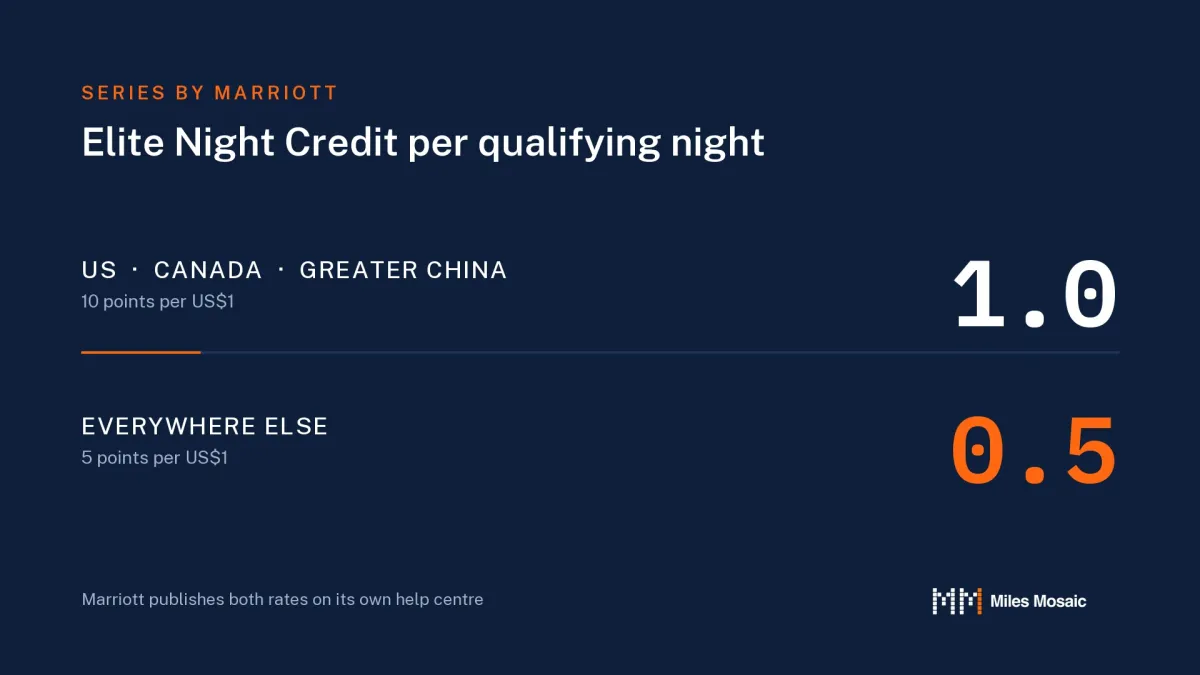
A night at a Series by Marriott hotel earns one Elite Night Credit in the United States, Canada and Greater China. Everywhere else in the world, the same night earns half a credit. Marriott publishes both figures on its own help centre, and the difference is not a promotion or a regional trial. It is simply how the collection earns.
The same split applies to points. Ten Marriott Bonvoy points per US dollar in those three markets, five per dollar everywhere else. For a member counting towards 50 nights, that is the difference between 50 stays and 100.
Marriott's Bonvoy terms do not carry this detail. They list Series by Marriott among participating brands and point to a separate page for earning, which is where the two rates live. Marriott's help centre answers the question directly: at Series hotels in the United States, Canada and Greater China members earn 10 points per US dollar and one Elite Night Credit per qualifying night, and "at all other Series by Marriott hotels" they earn 5 points per dollar and half of one Elite Night Credit.
| Where the hotel is | Elite Night Credits per qualifying night | Base points per US dollar |
|---|---|---|
| United States, Canada, Greater China | 1 | 10 |
| Every other Series by Marriott hotel worldwide | 0.5 | 5 |
Marriott defines Greater China as mainland China, Hong Kong, Macau and Taiwan.
Two things about that table are worth saying plainly, because most coverage of this rule has framed it as an Asia story. It is not. The half rate applies to every Series by Marriott hotel outside those three named markets: the United Kingdom, continental Europe, Australia, the Gulf, Latin America, Africa, and all of Asia other than Greater China. India, where much of the collection currently sits, is on the half-credit side. So is Singapore.
And the two halvings compound on the same stay. A member outside the three full-rate markets earns half the night credit and half the base points from one booking.
Take five nights at $150 a night, all of it qualifying charges, booked by a Platinum Elite member who receives the usual 50 per cent bonus on base points. Taxes and non-qualifying items are excluded, as they are from base-point earning generally.
| Santa Monica, California | Singapore, or Pune, or London | |
|---|---|---|
| Elite Night Credits | 5 | 2.5 |
| Base points | 7,500 | 3,750 |
| Platinum 50 per cent bonus | 3,750 | 1,875 |
| Total points | 11,250 | 5,625 |
Same brand, same booking path, same money. Half the return, decided entirely by which side of the line the property sits on.
Series is not a hotel brand in the way Courtyard or Westin are. Marriott describes it on its own brand page as "a global collection of independent, regional brands, each with a distinct point of view and the simple basics that guests need", positioned around value rather than facilities. It is a wrapper placed over existing hotels rather than a new build-out.
That is the mechanism behind the split. Marriott is bringing independent regional hotels into Bonvoy at a lower cost of participation, and the earning rate reflects what those properties are paying into the programme. It is a commercially coherent decision. It is also invisible to a member at the point of booking, because the hotel carries the Series by Marriott name and appears in Marriott's own search results alongside everything else.
The properties Marriott features on that page make the geography concrete. Four of the five are The Fern hotels in India, at Bodhgaya in Bihar, Bhiwandi in Maharashtra, Pune, and Jambughoda in Gujarat. The fifth is FOUND Hotel in Santa Monica, California. Same collection, same Bonvoy branding, same booking path. The Santa Monica night is worth twice the Pune night, in both currencies. That list will grow, and the line it sits either side of is the one to watch.
This is the detail that changes how the rule should be read, and it is published on the same Marriott page as the earning rates. Series participates in the ordinary Bonvoy elite benefits, at the ordinary tier percentages, subject to the same published conditions and exceptions that apply everywhere else in the programme. Nothing is scaled back for being a Series hotel.
| Tier | Bonus points | Headline benefits at a Series hotel |
|---|---|---|
| Member | None | Member rates, mobile check-in |
| Silver Elite | 10 per cent | Ultimate Reservation Guarantee, priority late checkout |
| Gold Elite | 25 per cent | 2pm late checkout, enhanced room upgrade, 250-point welcome gift |
| Platinum Elite | 50 per cent | 4pm late checkout, enhanced room upgrade, welcome gift or breakfast for two, guaranteed room type |
| Titanium Elite | 75 per cent | All of the above plus the 48-hour guarantee |
| Ambassador Elite | 75 per cent | All of the above plus Your24 |
Those conditions are not trivial and they are the same ones that apply portfolio-wide. Room upgrades and Gold late checkout are availability-based; the 4pm checkout carries the usual resort and convention-hotel exceptions; the 48-hour guarantee has property, date and rate exceptions. The Platinum-and-above welcome benefit is a choice of 500 points per stay or restaurant breakfast per night for the member plus one, and it converts to the 500 points where a property has no eligible restaurant, which at a value-positioned collection will often be the case. But the structure is intact. Marriott has reduced what a Series night pays into your account and has not reduced what it pays you at the door.
That distinction matters for how you should use the collection. As somewhere to sleep on points-earning terms it is worth half of what it looks like. As somewhere to spend a night you were going to spend anyway, with your existing status honoured, it is worth exactly what a Marriott night is worth. Our Marriott Bonvoy guide covers how those benefits behave across the rest of the portfolio.
Bonvoy's thresholds are unchanged. What changes is how many stays it takes to reach them if your nights are half-credit nights.
| Tier | Nights required | Half-credit nights required |
|---|---|---|
| Silver Elite | 10 | 20 |
| Gold Elite | 25 | 50 |
| Platinum Elite | 50 | 100 |
| Titanium Elite | 75 | 150 |
| Ambassador Elite | 100, plus a qualifying-spend threshold | 200, plus the same spend |
Nobody builds a qualification year entirely out of one brand collection, so the honest version of the risk is smaller and more specific than doubling. It is the member who plans 52 nights to clear Platinum, books a run of eight Series nights in Southeast Asia or India because the rate was good, and lands on 48. That is not a hypothetical failure mode. It is what happens when a rule that varies by country is applied to a total that does not.
The spend requirement at Ambassador is worth a separate note. Marriott measures it in money rather than in credits, so a half-credit night still contributes its full cash value there. The half rate costs you nights, not spend.
The arithmetic that actually decides an outcome is not the doubling. It is the shortfall. Take a member who books 52 hotel nights in a year, aiming at the 50 required for Platinum, and vary only how many of those nights are half-credit Series nights outside the three full-rate markets. Every night is assumed to be a qualifying night, and every night that is not a Series night is assumed to earn one full credit.
| Half-credit Series nights | Full-rate nights | Credits earned | Against a 50-night target |
|---|---|---|---|
| 0 | 52 | 52 | Clears with two to spare |
| 4 | 48 | 50 | Clears exactly |
| 8 | 44 | 48 | Two short |
| 16 | 36 | 44 | Six short |
Four Series nights is the whole margin. That is one long weekend, booked because the rate looked good, and it is the reason this rule is worth knowing in advance rather than in January. The failure mode is not a member who books nothing but Series hotels. It is a member with a comfortable-looking buffer who spends it without noticing.
The same logic runs in reverse and is the more useful half of it. If your booked nights already clear a tier with room to spare, the half rate costs you nothing you were going to use, and a cheaper Series rate is simply a cheaper room with your status honoured. The rule only bites inside the last handful of nights before a threshold.
The practical advice is short, because the rule is invisible until it is not.
Look at the Elite Night Credits line in your Bonvoy activity after a Series stay, rather than at the night count on your dashboard. If a two-night stay in Bangkok posted one credit rather than two, that is the rule operating correctly and not an error to raise with customer service. Marriott publishes the earning rate but not the accounting treatment, so how a lone half credit displays in an account, and whether two half nights from separate stays combine into one whole credit, is not something the programme documents. Check the posted figure rather than assuming it.
If you are picking between a Series property and a full-rate brand at a similar price late in a qualification year, the arithmetic is no longer about the nightly rate. Our guide to how the big four hotel programmes count qualifying nights covers the other cases where a night quietly does not count, including third-party bookings and group rates.
The interesting question is not whether half a credit is fair. It is what the split says about the programme's direction.
Marriott has spent several years adding inventory faster than it has added owned or managed hotels, mostly through soft brands, collections and franchised conversions. Series is the furthest step in that direction: independent hotels, regional brands, one Bonvoy wrapper. Growing a programme that way puts pressure on the promise that a night is a night, because the properties are not paying in equally. The two-rate structure is Marriott resolving that pressure in the open rather than by quietly thinning benefits at those hotels, and the elite benefit table above is the evidence that it chose the first route.
There is a real case for that. A member who books a Series hotel at a Series price and knows the rule is getting exactly what was advertised. The problem is the second clause. The rule sits on a help-centre page reached through a link inside the programme terms, and it is not on the booking path. Very few members chasing a night target will encounter it before the credits post.
Which is the reason to write it down. Keeping this straight across programmes is the mundane part, and it is roughly what Miles Mosaic is for. It tracks elite nights, balances and status across 31 loyalty programmes, 24 airline and seven hotel, and forecasts whether booked and planned stays will actually reach the tier you are aiming at, without ever asking for an account password. Explorer is free and carries ads; Pro removes them at $14.99 a month. If you are weighing whether hotel nights are the right place to spend the effort at all, we have looked at hotel status against airline status.
See your requalification forecast in under a minute. No account, and never a loyalty password.
Forecast my status, free →Share
Last reviewed: · How we research and update
Marriott Bonvoy in 2026: elite tiers, variable award pricing, PointSavers, Cash + Points, Stay for 5 Pay for 4, and when the programme dese…
Read article →A plain-English guide to how Marriott Bonvoy, Hilton Honors, World of Hyatt, IHG and Accor ALL count qualifying nights for elite status in …
Read article →Marriott Bonvoy Platinum Elite in 2026: 50-night gate, suite upgrades, lounge access, and how to actually qualify.
Read article →A 2026 decision framework for choosing between airline and hotel elite status: qualification cost, real benefit value, and the credit-card …
Read article →