Cathay's 2027 Loyalty Overhaul: Calendar Years, Rollover and the New Diamond Exec, Explained
Cathay's programme changes on 1 January 2027: Status Points stop resetting, membership moves to calendar years, rollover arrives and Diamon…
Read article →Independent Miles Mosaic guide. No programme partnerships, no account linking, no scraped balances. Sources cited below; corrections welcomed.
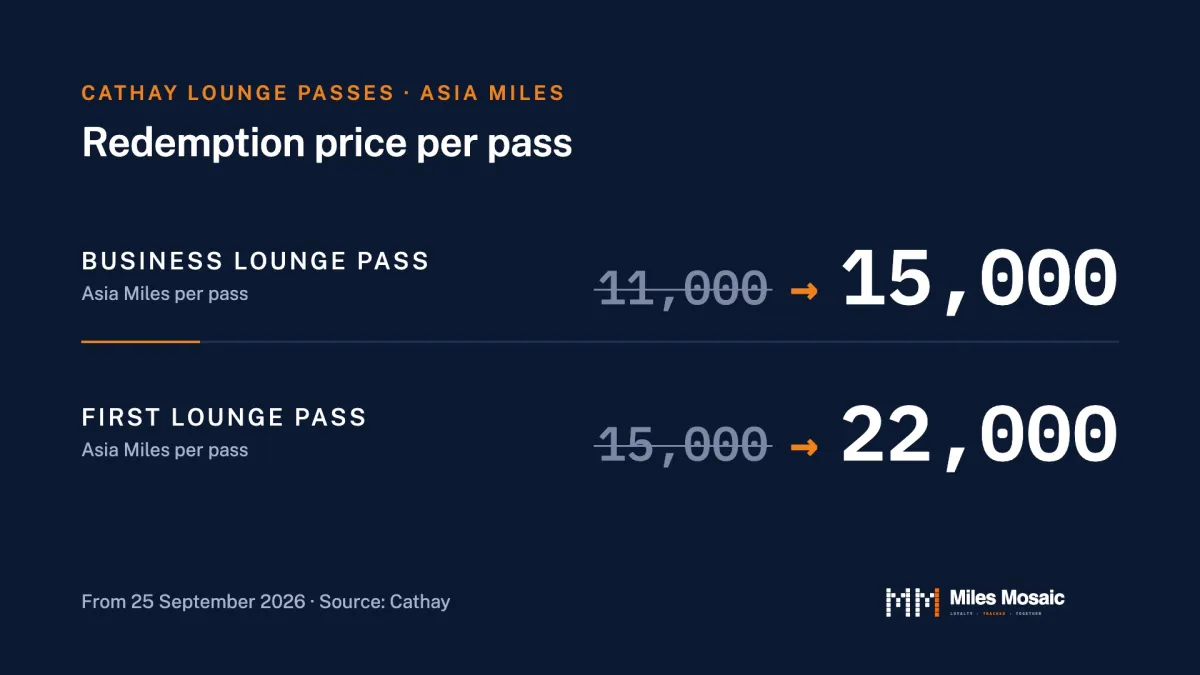
An Asia Miles lounge pass now costs 15,000 Asia Miles for a Cathay Pacific Business class lounge and 22,000 for a First class lounge, up from 11,000 and 15,000 on 25 September 2026. Passes are now digital, work only in Cathay-operated lounges before Cathay flights, and can be redeemed only by Silver members and above or eligible co-brand cardholders.
That last clause surprises people, and it changes who this price rise actually hits. A lounge pass is often described as the way a member without status gets into a Cathay lounge. Under Cathay’s own terms it mostly is not. It is a way for members who already have lounge access to bring someone in, or to send someone in without them.
The new prices are set out in Cathay’s notice on digital redemption lounge passes, last updated on 20 August 2026. The old prices applied to redemptions made up to 23:59 Hong Kong time on 24 September; the new ones from 00:00 on 25 September.
| Pass | Before | From 25 Sep | Change |
|---|---|---|---|
| Business lounge | 11,000 | 15,000 | +36% |
| First lounge | 15,000 | 22,000 | +47% |
The neatest way to read that table is diagonally. A Business pass now costs exactly what a First pass cost a month ago. Nothing about the lounges changed on 25 September; the price of walking into them did.
The same notice moves the passes into the app. A pass redeemed online is stored in the member’s profile and shown as a QR code from My Rewards in the Cathay Pacific or Asia Miles by Cathay app, and it can be shared with a redemption group nominee. That is a sensible change in its own right. It also arrived in the same announcement as the price rise, which is how these things usually arrive.
The eligibility rule sits in the terms on Cathay’s lounge pass redemption page, and it matches the Cathay membership programme terms and conditions in force since 1 January 2026. Silver, Gold and Diamond members, and select Cathay co-branded credit card holders, can redeem a Business class pass. Only Diamond members can redeem a First class pass.
Put that next to what each tier already gets through the door, and the purpose of the pass becomes clear. Cathay’s lounge admittance rules give every tier from Silver upwards unlimited departure lounge access, regardless of cabin, when departing on an eligible flight.
| Tier | Business lounge | First lounge | Can redeem |
|---|---|---|---|
| Green | No | No | Co-brand card only |
| Silver | Member only | No | Business |
| Gold | Member + 1 | No | Business |
| Diamond | Member + 2 | Member + 2 | Business, First |
Under clause 15 of the membership terms, those tier guests must be on the member’s booking or flying the same route on the same date, and must enter the lounge with the member.
On flights both marketed and operated by Cathay Pacific, which is what the membership terms require for Silver’s own lounge access, a Silver member can already walk in alone. There the pass buys a seat for someone else: a partner on the same booking, or a family member flying on a different day. A Diamond member can already use First class lounges with two guests, so a First pass is really a way to send a nominee into a First lounge unaccompanied. The redeemed pass is a companion and gifting product, and the price rise is, in practice, a price rise on bringing people with you.
The Green member who flies Cathay in Economy a few times a year, holds a modest Asia Miles balance and wants a quiet hour before a long flight, is the person most write-ups have in mind. Unless that member holds an eligible co-branded card, Cathay’s terms do not let them redeem a pass at all. They can still use a pass that an eligible member shares with them, but their own route to one runs through Status Points, which is covered below.
Before deciding whether 15,000 miles is fair, it is worth being clear about what the pass buys, because the conditions narrow it more than the price does. On Cathay’s wording, a redeemed pass:
The first two conditions do most of the work. A pass does nothing for you on a Japan Airlines or Qantas flight on that airline’s own number, even though both are oneworld partners, and it does nothing at an airport where Cathay passengers are sent to a lounge run by someone else. Hong Kong, where Cathay runs several lounges of its own, is where a pass is most obviously usable.
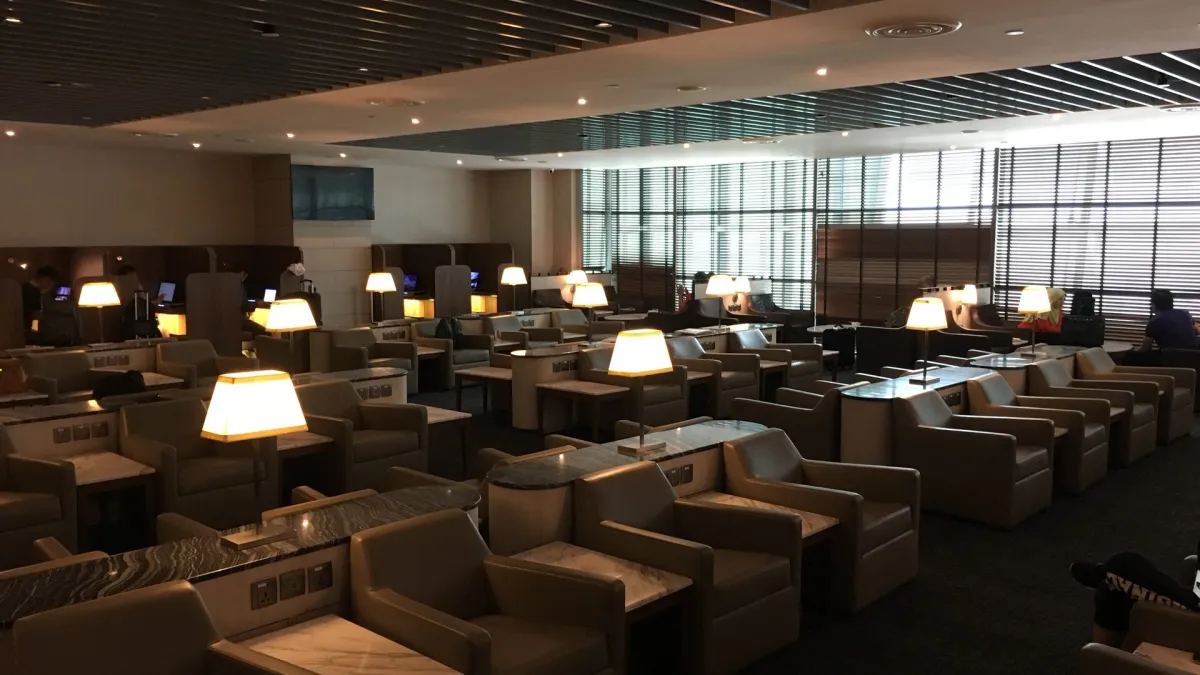
Singapore is covered too. Cathay lists a Cathay-branded Cathay Pacific Lounge at Changi in the Transit Hall of Terminal 4, on the mezzanine level, opening three hours before the first Cathay Pacific departure of the day, and presents it as its own exclusive Changi lounge, Noodle Bar included. A Singapore departure on a CX flight number is squarely the kind of trip the pass is meant for.
What counts as an eligible flight is less tidy. Cathay does not define the word beyond “marketed or operated by Cathay Pacific” and the boarding-pass check. Its terms say nothing either way about award tickets, so nothing published excludes a flight you booked with miles. A flight sold under a CX number but operated by a partner appears to meet the wording, but the pass only helps if the departure airport has a Cathay-operated lounge, which partner-operated routes often do not. Because a redeemed pass cannot be cancelled, confirm the specific flight with Cathay before redeeming if your trip sits in either grey area.
Printed passes redeemed on or before 00:00 Hong Kong time on 25 September 2026 remain valid, and can be used within one year of the date they were redeemed. If you redeemed one in the summer at the old price, it is still good for its original year. There is nothing to do with it except remember when that year ends.
The redeemed pass is not the only kind. Cathay also hands out lounge passes as mid-status benefits, earned by collecting Status Points partway through a tier. Cathay’s mid-status lounge pass page sets out the current ladder, and clause 21 of the membership terms repeats it.
| Tier | Milestone | Passes | Shareable with |
|---|---|---|---|
| Green | 200 | 1 Business | Companion |
| Silver | 450 | 2 Business | Companion |
| Gold | 800 | 2 Business | Companion or nominee |
| Diamond | 1,400 | 2 First or Business | Companion or nominee |
Cathay defines a travel companion as someone on the same booking, or flying on the same date between the same origin and destination. The membership terms also let the member use any of these passes personally, although from Silver upwards the member already has lounge access. The same Cathay-operated-lounge and Cathay-flight conditions apply, and the passes last 12 months from issue.
One catch applies throughout 2026: Cathay is running two counters at once. Under clause 13 of the membership terms, your balance for the current membership period resets to zero when you move up a tier, so a Silver member’s 450-point milestone uses the current membership-period balance, which resets on renewal or upgrade, rather than counting from January. Separately, under clause 14, the Status Points you earn across calendar 2026 decide your status on 1 January 2027: 300 for Silver, 600 for Gold and 1,200 for Diamond. The two numbers can differ, so check both before assuming a trip lands a pass or a tier.
For the Green member, the first line is the one that matters. A member with no status who reaches 200 Status Points in 2026 receives one Business lounge pass they can use themselves. It is the only rung on the ladder where the pass is genuinely useful to the member personally, because every tier above Green already opens the door, and it is how a Green member without a co-branded card earns a pass of their own. They may also be given a shareable pass by another member.
The next rung is status itself. According to Cathay’s overview of status benefits, Silver sits at 300 Status Points, Gold at 600 and Diamond at 1,200. The ladder is short: 200 points for one pass, 300 for access every time you fly Cathay for the rest of the membership period. If you are not sure how close your booked trips take you, our Asia Miles Status Points forecaster projects them against those thresholds.
The price rise is easiest to judge against the alternatives Cathay itself offers. There is a cash option that most members overlook. Through Manage Booking, Silver, Gold and Diamond members can buy a lounge pass for a travel companion on the same booking at a flat USD 100, plus any tax, for a published list of selected lounges. It applies only to tickets issued by Cathay Pacific, with numbers beginning 160, on flights both marketed and operated by Cathay Pacific.
| Route | Price or requirement | Who |
|---|---|---|
| Redeemed pass | 15,000 miles | Silver+ or co-brand card |
| Paid pass | USD 100 + tax | Silver+, selected lounges |
| Green milestone | 200 Status Points | Green, 1 pass |
| Silver milestone | 450 Status Points | Silver, 2 passes |
| Gold status | 600 Status Points | 1 guest each visit |
Now the arithmetic. At 15,000 Asia Miles against a USD 100 cash fee, redeeming the pass gets you about 0.67 US cents of value per mile before tax; any local tax on the cash pass pushes that figure up, so divide the full cash price by 15,000 for your own case. At the old price of 11,000 miles it was about 0.91 US cents. So where the cash pass is available, redeeming miles makes sense only if you would not otherwise get more than two thirds of a US cent per mile from your balance. If you would otherwise put the miles towards a flight award, price that award in cents per mile first. Either way, the rise has moved the break-even point further against the pass.
The redeemed pass still wins in the places cash cannot reach. The paid pass covers only selected lounges and only a companion on the same booking. The redeemed pass works across Cathay-operated lounges, can be sent to a nominee travelling alone, and needs no cash at all. Unlike the paid companion pass, it can serve a nominee travelling alone, such as a grown child flying through Hong Kong on their own or a partner flying home on a different day. Before redeeming for that, check whether you hold an unused shareable Gold or Diamond milestone pass, which does the same job without spending miles.
Gold is the line that makes both obsolete for the regular companion. A Gold member brings one guest into Business lounges on every eligible departure. Anyone buying three or four passes a year for the same person is paying, in miles or dollars, for a benefit that sits one tier above them.
The mid-status table above has a limited shelf life. Cathay moves to calendar-year qualification on 1 January 2027, and its key changes to the membership programme remove most mid-status lounge passes for points earned from that date. Silver keeps its 450-point milestone with two Business class lounge passes, for the member or travel companions travelling together on a Cathay Pacific flight. Gold loses its passes. Diamond’s are replaced by two single-sector Upgrade Passes on reaching the tier.
Green is the open question. Cathay says the current Green mid-status benefits will be replaced by new Green milestone benefits from 1 January 2027, and its 2027 programme page says the details will be announced in late 2026. At the time of writing they have not been published, so nobody can yet say whether a Green member will still earn a lounge pass in 2027.
We covered the wider overhaul in Cathay’s 2027 loyalty overhaul, explained. For this article, the practical point is timing. Cathay says mid-status benefits earned during 2026 remain valid for 12 months from issue, so a pass earned before 31 December 2026 is still usable well into 2027. A Green member sitting at 150 or 180 Status Points with a Cathay trip planned before year-end has a concrete reason to check which side of 200 that trip lands them.
If you are based in Singapore and mainly collect KrisFlyer miles, note that KrisFlyer is a Star Alliance programme and has no bearing on Cathay lounges. An Asia Miles balance held on the side, topped up by card transfers and the occasional Cathay flight, cannot buy a lounge pass for a Green member at all unless they hold an eligible co-branded card.
It also matters where those Cathay flights are credited. Status Points, and therefore the 200-point pass and the 300-point Silver tier, accrue only in Cathay’s own programme. A traveller who credits Cathay flights to another oneworld programme earns that programme’s status currency instead. Cathay’s admittance rules let oneworld Sapphire members into Cathay-operated Business lounges with one guest, and Emerald members into First and Business lounges with one guest, when departing on Cathay Pacific or oneworld carrier flights; the oneworld lounge rules require that flight to be both marketed and operated by a oneworld airline, and the guest must be on such a flight too. One temporary exception: while The Wing, First in Hong Kong settles in after reopening, Cathay is directing oneworld Emerald members to The Pier, First or other eligible lounges instead. If your Cathay flying already earns you a oneworld tier elsewhere, that is a better outcome than any pass. Our comparison of KrisFlyer, Asia Miles and Avios covers where each kind of flying is best credited, and the lounge access checker shows which doors a given status opens.
Two housekeeping points for smaller balances. The pass is not needed to keep miles alive: under Cathay’s terms, Asia Miles do not expire as long as the account has at least one eligible transaction, such as earning, redeeming or transferring in, every 18 months. And a pass that goes unused within its 12 months is simply lost, with no refund of the miles.
This is not an award-chart devaluation, and it will not show up in any comparison of redemption prices between cities. It is the repricing of a benefit that sits next to the award chart, which is where much of the quiet change in loyalty has happened this year, a pattern we traced in the devaluation that misses the award chart. It is also the second cost increase from Cathay in two months, after the fuel surcharge rise on tickets issued from 1 August. The familiar shape is here as well: a digital convenience arrives at the same moment as a price rise, and the headline leads with the convenience.
For members, the defence is the same as for any repricing. Know which of your benefits are earned and which are bought, and know how close you are to the thresholds that turn a purchase into an entitlement. For the wider set of ways in, from status to cards to paid memberships, our guide to airport lounge access in 2026 lays out every path.
The hard part is rarely a single rule in isolation. It is seeing where your booked Cathay flights leave you against 200, 300, 450 and 600 Status Points before the year closes, alongside whatever you are chasing elsewhere. That cross-programme view is what Miles Mosaic is built for: it tracks miles, points and elite status across 31 airline and hotel programmes in one place, without asking for any account password.
Every price, threshold and condition above was checked against Cathay’s own pages on 29 September 2026. External sites open in a new tab.
See your requalification forecast in under a minute. No account, and never a loyalty password.
Forecast my status, free →Share
Last reviewed: · How we research and update
Cathay's programme changes on 1 January 2027: Status Points stop resetting, membership moves to calendar years, rollover arrives and Diamon…
Read article →Five rule shapes decide every lounge door: alliance status, a network membership, a card, a ticketed cabin or paid entry. What each covers,…
Read article →A 2026 comparison of KrisFlyer, Asia Miles, and Avios: expiry rules, redemption strengths, transfer access, and which programme fits which …
Read article →Cathay raises carrier-imposed fuel surcharges by up to 41% on tickets issued from 1 August 2026. The new per-sector figures, the booking-da…
Read article →