The Best Frequent Flyer Programme for Singapore-Based Travellers in 2026
Which loyalty programme actually suits a Singapore-based traveller in 2026: which bank points reach which airline, what the surcharges cost…
Read article →Independent Miles Mosaic guide. No programme partnerships, no account linking, no scraped balances. Sources cited below; corrections welcomed.
Singapore’s sustainable aviation fuel levy applies to tickets sold from 1 October 2026 for flights departing Singapore on or after 1 January 2027. It costs between S$1.00 and S$41.60 per passenger depending on distance band and cabin, applies to award tickets as well as cash fares, and does not apply to transit passengers.
The Civil Aviation Authority of Singapore confirmed the start date on 3 September 2026, after deferring the scheme in March. The amounts are modest. The mechanism is the interesting part, and it has a consequence that has gone almost unremarked: the levy attaches to the date the ticket is sold, not the date you fly.
That means a ticket sold on or before 30 September 2026 escapes the levy entirely, whatever its departure date. For anyone who books award tickets far ahead, which is most people reading this, that is a small, dated arbitrage sitting in plain sight for the rest of September.
One word in that rule is doing a lot of work, and it is worth being exact about it. CAAS keys the levy to the date a ticket is sold, which in practice means ticketed and paid for, not the date you made a reservation. A held booking, an unticketed award reservation or a fare on a payment deadline is not a sale. If you are relying on the September cut-off, make sure the ticket is actually issued rather than merely booked.
It is worth saying immediately that for most travellers the sum involved is a few Singapore dollars. This is not a devaluation and it should not reshape anyone’s plans. But the rule is worth understanding properly, because the parts of it that are counter-intuitive are the parts that will be misreported.
Singapore has set a target of 1 per cent sustainable aviation fuel uplift for 2026, with a goal of raising that to between 3 and 5 per cent by 2030. Rather than mandate that airlines buy the fuel themselves, CAAS has taken what it calls a fixed cost envelope approach: it charges a set amount per passenger, pools the money, and buys the fuel centrally through a non-profit company, the Singapore Sustainable Aviation Fuel Company. The money can be spent only on sustainable fuel, on the environmental attributes attached to it, and on the administration of both.
The practical effect for a traveller is that the charge is fixed and predictable rather than folded invisibly into a fare. CAAS requires airlines to display the levy as "a distinct line item on the air ticket sold", in the same way as an airport tax.
The rate depends on two things: how far the first flight goes, and which cabin you are in. The rate table CAAS published in November 2025 groups every destination from Singapore into four geographical bands and splits cabins into two. Economy Cabin covers both Economy and Premium Economy. Premium Cabin covers Business and First, and is charged at four times the Economy rate, a ratio CAAS takes from the industry norm for apportioning carbon emissions between cabins.
| Band | Regions | Economy Cabin | Premium Cabin |
|---|---|---|---|
| I | Southeast Asia | S$1.00 | S$4.00 |
| II | Northeast Asia, South Asia, Australia, Papua New Guinea | S$2.80 | S$11.20 |
| III | Africa, Central and West Asia, Europe, Middle East, Pacific Islands, New Zealand | S$6.40 | S$25.60 |
| IV | Americas | S$10.40 | S$41.60 |
So: S$1.00 in economy to Bangkok, S$2.80 to Tokyo, S$6.40 to London, S$10.40 to New York. In business those become S$4.00, S$11.20, S$25.60 and S$41.60.
Two details in that table catch people out. New Zealand sits in Band III with Europe rather than in Band II with Australia, so a Singapore to Auckland flight is charged at more than twice the Sydney rate. And Premium Economy is charged as Economy, not as a premium cabin, which makes it the only cabin where the levy is cheap relative to the fare.
These rates are lower than CAAS’s own first estimates. When the scheme was announced in November 2025, the authority had previously put the economy figures for Bangkok, Tokyo and London at around S$3.00, S$6.00 and S$16.00. CAAS attributed the lower final figures to the lower prevailing cost of sustainable aviation fuel. That is worth remembering when the rates are next reviewed: they track a fuel cost, and fuel costs move in both directions.
CAAS set the current dates in a deferral notice on 25 March 2026, citing the effect of the conflict in the Middle East on airlines and passengers. The original plan had been tickets sold from 1 April 2026 for departures from 1 October 2026. Everything slid by six months.
The 3 September confirmation left the passenger rates and bands untouched and deferred the cargo levy by a further year, to services sold from 1 October 2027 for flights departing from 1 January 2028. CAAS gave the reason plainly: cargo operations are more diverse and involve a wider range of stakeholders, so the collection mechanism needs longer to build.
CAAS does not discuss redemption tickets anywhere, and it does not need to: the levy is set on a per-passenger basis, applies to every Origin-Destination passenger, and is collected by the airline as a line on the ticket. Nothing in any of the three media releases exempts a ticket bought with miles, so on the plain reading of the rule an award passenger pays it like anyone else. That is an inference from the scope CAAS has published rather than a statement CAAS has made about awards.
That matters more than the headline number suggests, and for a reason that is easy to miss. On a cash fare, an airline facing a new S$25.60 charge in business class has a base fare to work with, and can absorb part of it to hold a price point on a competitive route. On an award ticket there is no base fare to absorb it into. You pay the taxes, fees and carrier charges in cash, and a new per-passenger charge lands on that cash total in full. As a share of what you actually hand over, a fixed levy therefore weighs more on a redemption than on a comparable cash fare. How much more depends on the route, because an award ticket on a carrier that levies heavy surcharges already carries a substantial cash total.
The absolute numbers are still small. Two people in business class to Europe on award tickets are looking at S$51.20 between them. A family of four in business to the United States is looking at S$166.40, which is the point at which it stops being noise. If you are weighing which programme to redeem from out of Changi, this does not change the answer, and our comparison of the best frequent flyer programme for a Singapore base still turns on award availability and surcharges rather than on a charge every carrier pays equally.
One rule in the November 2025 release deserves more attention than it has had. For flights with multiple stops, CAAS sets the levy by "the immediate next destination after departing Singapore".
Read literally, that means a Singapore to Bangkok to London itinerary attracts the Band I rate on the Bangkok sector rather than the Band III rate a direct Singapore to London flight would carry. In business class that is the difference between S$4.00 and S$25.60.
Two cautions before anyone reroutes anything. First, the banding rule itself is clear, but CAAS does not spell out whether an ordinary connection on a single ticket counts as "multiple stops" for its purposes, and that is what decides whether this applies to a normal connecting award itinerary. The rule is published; its scope is not. Second, even on the most favourable reading the saving is S$21.60 per passenger in a premium cabin. Nobody should add a connection to a long-haul redemption for that. It is worth knowing when you are already weighing a connection against a direct flight for other reasons, and no more than that.
The levy applies only to Origin-Destination passengers, which is CAAS’s term for someone whose journey starts in Singapore. A passenger connecting through Changi from somewhere else to somewhere else is explicitly out of scope. Given how much of Changi’s traffic is exactly that, this is a meaningful carve-out, and it means the levy is a charge on leaving Singapore rather than a charge on using it.
Training flights and flights for charitable or humanitarian purposes are also exempt.
If you already know you are flying out of Singapore in 2027 and you were going to book anyway, book now. KrisFlyer award space is typically reported as loading 355 days ahead, at 8am Singapore time, though Singapore Airlines does not publish the window itself. On that figure a booking made on 30 September 2026 reaches to around 20 September 2027, which covers most of the 2027 travel year. Booking windows differ widely between programmes, so check the one you are actually redeeming from rather than assuming it matches KrisFlyer. If you are short of the balance you need, note that KrisFlyer will not even show you award space below a minimum balance threshold, which is a separate obstacle to booking early.
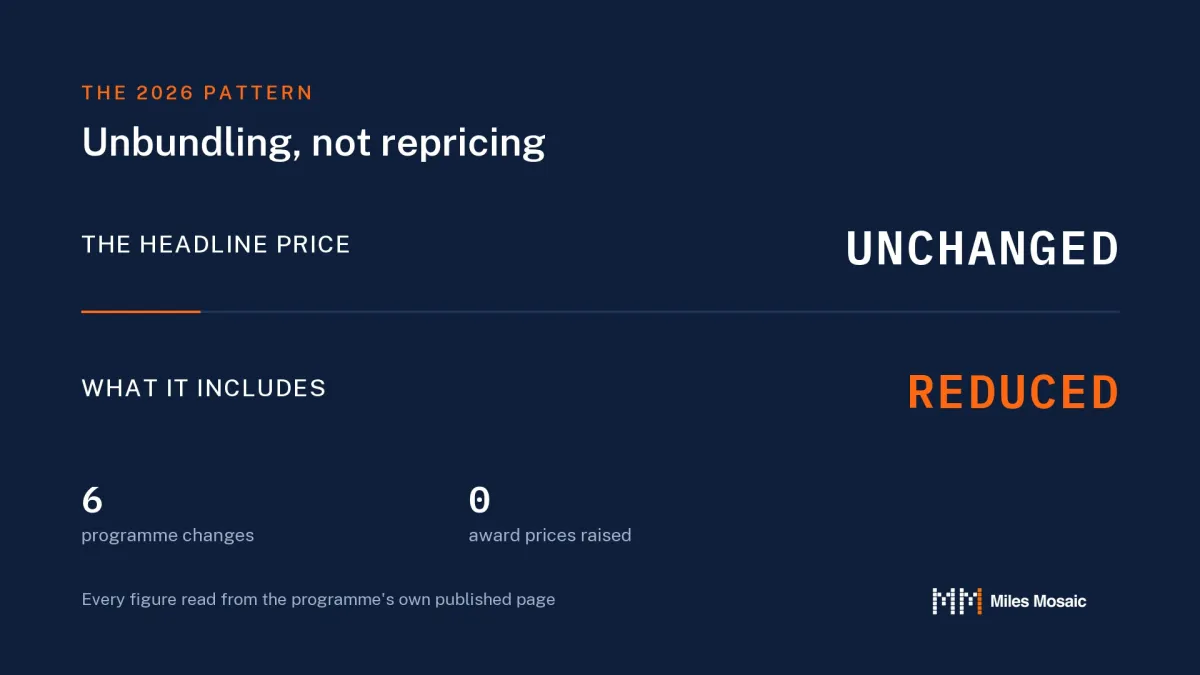
If you were not going to book anyway, do nothing. Committing to an award itinerary you are unsure about, in order to avoid a charge of between S$1.00 and S$41.60, is a poor trade. That is doubly true now that several programmes have made a later change more expensive than it used to be, which is the pattern we set out in unbundling, the new devaluation. The levy is not a reason to lock in a trip.
Watch the reissue question. CAAS says nothing about whether voluntarily changing a ticket after 1 October 2026 creates a new sale that picks up the levy. If it does, a pre-October booking that you later move loses its exemption, and that would matter far more than the levy itself for anyone whose plans are provisional. Treat it as unresolved.
Check the line item in October. Once tickets start issuing under the new rule, confirm the charge appears as its own line rather than folded into the fare. CAAS requires the former, and it is the simplest way to check you have been charged the right band.
The wider habit this rewards is unglamorous. A change like this is not a devaluation and will not show up in any programme’s news feed; it is a government notice with two dates in it, one about a decision you make and the other about a flight you take. Holding a handful of dates like that across several programmes at once, a booking window here, a qualification year there, an expiry date somewhere else, is the genuinely tedious part of frequent travel. It is what Miles Mosaic is for: booked trips, balances and status deadlines across 31 programmes on one screen, rather than reconstructed from a mailbox every few months. The free Explorer tier is ad-supported; Pro is $14.99 a month and ad-free.
Singapore is early to this, and other jurisdictions are watching how a levy of this design behaves, and specifically whether a fixed per-passenger charge, published in advance and shown separately on the ticket, generates less resistance than a mandate that pushes costs into fares. Reporting has described it as the first national levy of this kind on outbound flights, though that claim is not one CAAS itself makes and it is not asserted here.
The design is worth noting for its own sake. Passengers can see exactly what they are paying, the money is ring-fenced, and the rates were revised down when the underlying cost fell. Set against the direction of travel in loyalty programmes over the past two years, where prices move without notice and inclusions quietly shrink, a charge whose full rate table was published fourteen months before the first affected departure looks almost old-fashioned.
See your requalification forecast in under a minute. No account, and never a loyalty password.
Forecast my status, free →Share
Last reviewed: · How we research and update
Which loyalty programme actually suits a Singapore-based traveller in 2026: which bank points reach which airline, what the surcharges cost…
Read article →Singapore Airlines now blocks KrisFlyer award searches below an undisclosed balance. What is confirmed, what is not, and the workarounds th…
Read article →How PPS Club and Solitaire PPS Club qualification works in 2026: the PPS Value you need, non-flight earning caps, Reserve Value and how the…
Read article →Six loyalty changes kept a headline price or benefit name and cut what it contained. Why the usual devaluation tests miss most of them.
Read article →